
What travels is an invitation
Beyond China, Mid-Autumn is not one identical celebration repeated overseas. The examples considered here suggest a more useful answer: a festival takes local shape through the people who organise it, the spaces they can use and the people they hope to welcome. A lantern, a shop counter and a museum activity can offer very different entrances into the same season.
This is a story about those entrances, rather than a guide to upcoming events. Its photographs date from 2010 and 2023; its New York programme belongs to 2021. They let us examine specific choices without pretending to describe every household, community or present-day celebration. Singapore also deserves to be understood on its own terms: calling a festival 'abroad' from the perspective of China must not imply that Chinese Singaporeans are visitors in their own country.
For the wider festival context, begin with Mid-Autumn, reunion and distance. Here the question is narrower: what makes a celebration belong to the city in which it happens?
Singapore: look at the space around the lantern
Writing for the Singapore Chinese Cultural Centre’s Culturepaedia, researcher Lee Kok Leong describes a changing local festival: household moon worship has declined, while gatherings of friends and family remain important. He also notes celebrations organised by clan associations and public light displays. These are observations about Singapore, not a template for Chinese communities everywhere.
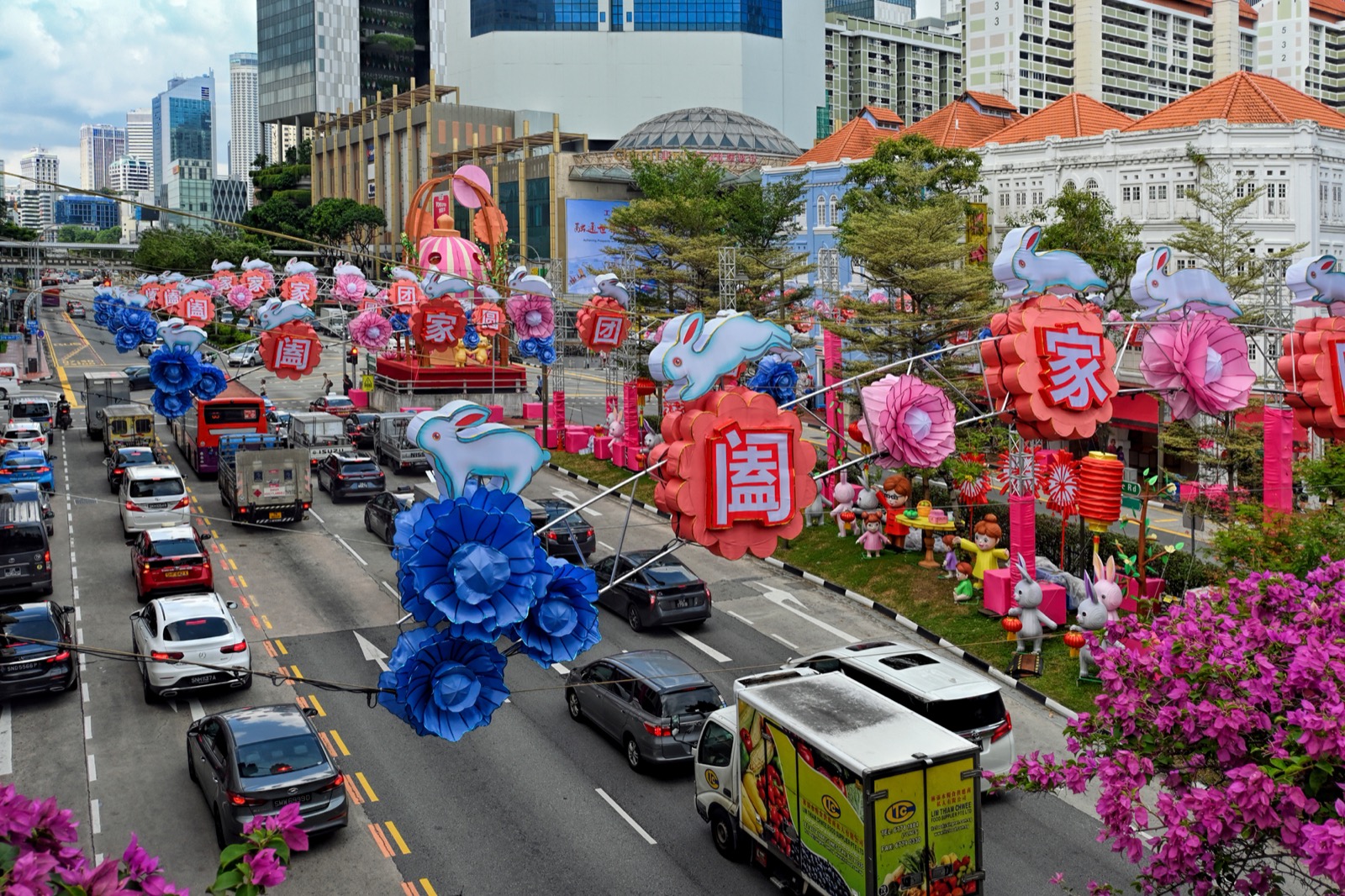
The 2023 photograph of Eu Tong Sen Street offers something more particular than a general statement about tradition. Pale rabbits and bright flower shapes extend above traffic, while buses, cars, shophouses and taller buildings remain visible. Look around the decorations, not only at them: the street continues to carry ordinary movement beneath the festival display. The installation changes what attracts attention along an existing urban route.
That is a useful way to read festival design. Ask how an installation redirects the eye and how it fits around the daily uses of a place. Its cultural work need not be confined to a symbol painted on its surface. Here, repeated forms make an ordinary street worth looking at differently. The photograph cannot tell us what any individual felt, but it gives us a place to begin looking.
San Francisco: a festival and a neighbourhood economy
The San Francisco Chinatown Merchants Association dates its first Autumn Moon Festival to 1991, after the Loma Prieta earthquake had disrupted Chinatown’s direct freeway connection. Its own account connects the celebration with the neighbourhood’s commercial and cultural life. This is the organiser’s description of a local initiative, not evidence that every Mid-Autumn gathering began for the same reason.
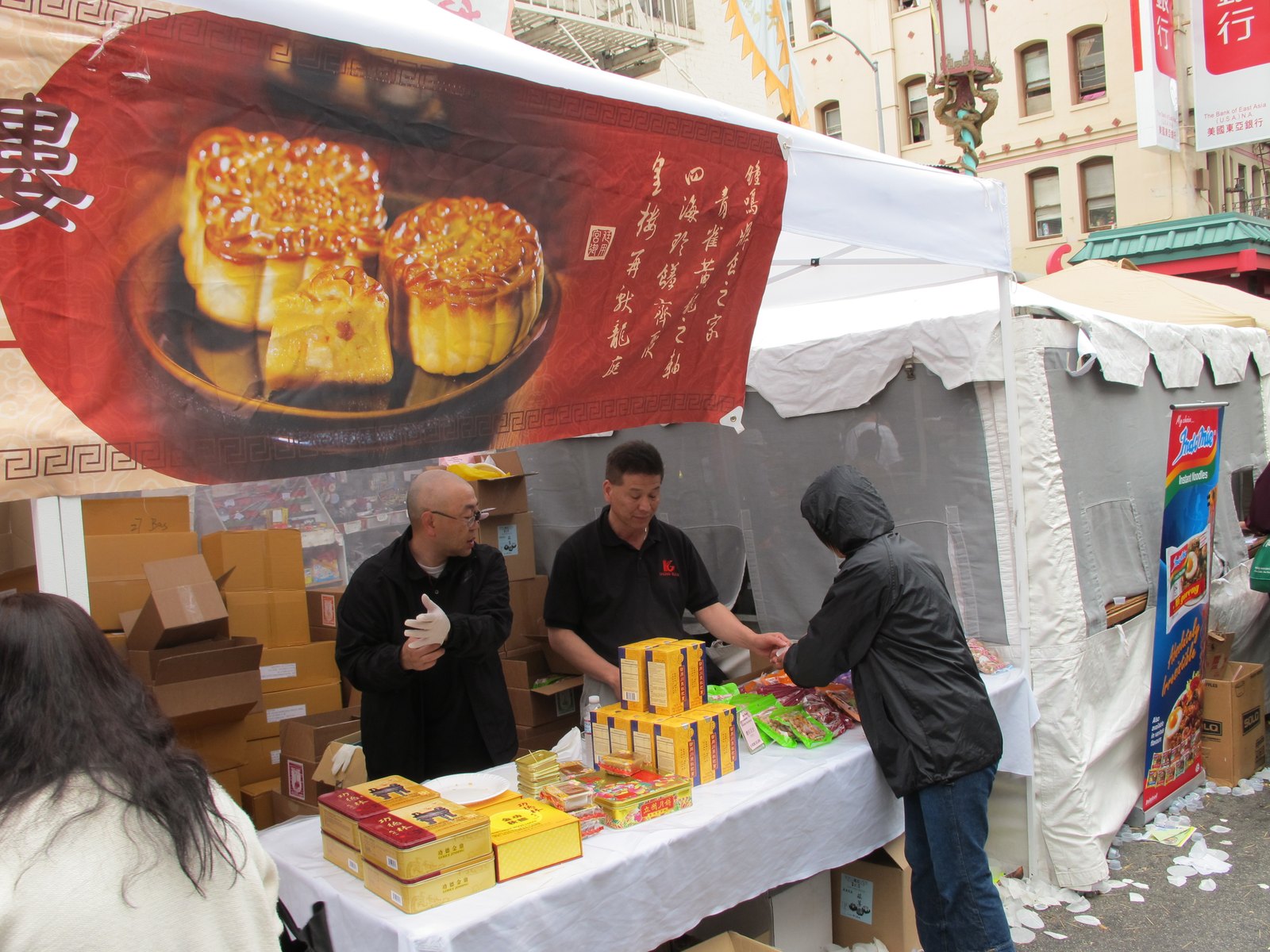
Gary Stevens’s 2010 photograph of a mooncake stall makes a different kind of contribution. Boxes are stacked on a folding table; a banner enlarges the cakes above the vendors; an exchange is taking place at the counter. The scene holds both packaging and people. It resists the familiar photograph of a single immaculate cake with its human setting removed.
We can read that contrast without deciding that commerce either saves or spoils a tradition. A purchase can be an encounter, but a photograph cannot tell us whether this customer is choosing a gift, buying for a family or simply curious. The more interesting question is what the stall makes possible: someone can approach, ask and choose. The festival becomes visible at the scale of a transaction, not only a spectacle.
New York: a programme can make room for a beginner
The Museum of Chinese in America advertised an in-person family celebration for September 18, 2021, with crafts and a martial-arts workshop led by the New York Chinese Cultural Center. Its published event record also invited families to virtual activities and storytime. This is an archived programme, not a description of the museum’s 2026 calendar or proof of how participants responded.
It leaves a useful question for a visitor: what would help you begin participating before you knew the whole story?
Belonging is not a photograph of an unchanged past
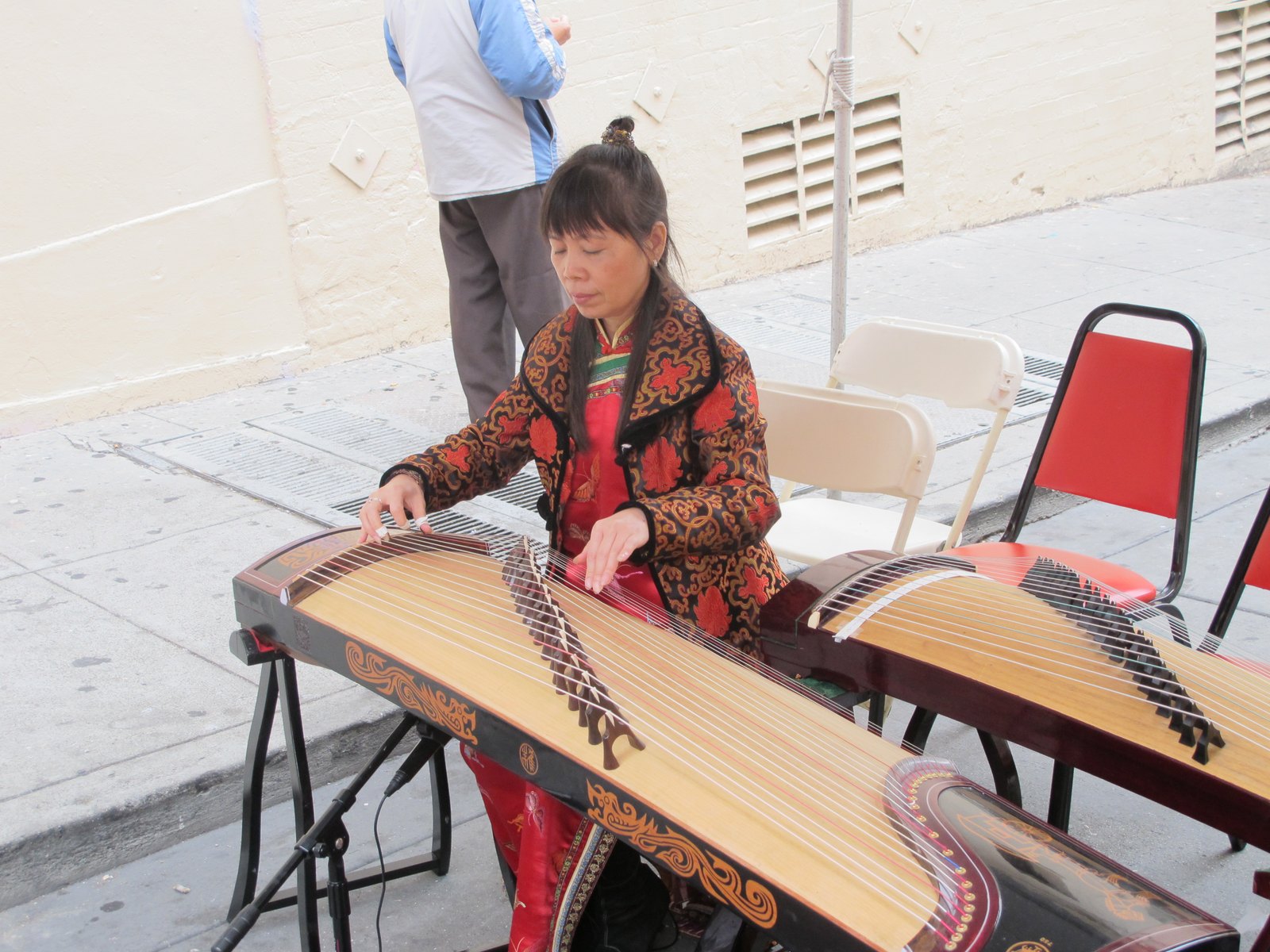
Another Stevens photograph records a guzheng player at the San Francisco event in 2010. Her hands, the instrument’s strings and the nearby folding chairs give us something concrete to examine. They do not establish her biography, the audience’s ancestry or the repertoire being played. Those limits matter: a cultural photograph is not permission to invent the lives beyond its frame.
There are other ways to think about connections across distance. UNESCO describes Kaiping’s diaolou and migration-linked architecture through the exchange of building forms and the continuing ties of overseas communities to Kaiping. The buildings are not evidence for a particular festival practice. They provide a separate case in which attachment becomes visible through choices made in a place.
For a different scale of encounter, follow the journal’s story of Quanzhou. Read these places alongside the festival photographs as different questions, not a single migration narrative. Who shaped this setting? What can the surviving evidence show? What remains unknown? Such questions let a cultural connection be meaningful without requiring it to be simple.
Arrive as a guest, not a collector of proof
If you encounter a Mid-Autumn celebration in your own city, start with the invitation that actually exists. Read who is organising it, whom it addresses and whether a session requires booking. An old photograph or an archived programme is a reason to become interested, not reliable information about this year’s opening hours. Let the organiser’s current notice settle the practical questions.
Once there, leave space for answers smaller than 'Chinese culture'. Ask a vendor about the cake on the table, or a facilitator about the activity they prepared. Do not ask one person to represent a country or explain every family’s customs. Request permission before making an identifiable portrait, and allow people to remain participants rather than turning them automatically into your content.
The reward is a more precise kind of attention. Instead of collecting proof that a tradition has survived unchanged, you begin to notice the work of making an occasion: a place arranged for meeting, a task offered to a stranger, an object chosen to share. A festival need not look the same everywhere to give people a reason to gather.
Join the conversation
What did this make you notice?
Which small invitation—a shared food, an activity or a public space—has helped you feel welcome at a celebration that was new to you?