
A translation that changes the story
Fenghuang is often translated into English as "Chinese phoenix," but the two are not the same mythical creature. The cycle of burning, death and return that many English readers associate with a phoenix is not the organizing story of the Chinese objects in this article. Here the bird appears in a garden, moves through clouds on porcelain and shares a dish with a dragon. None of these scenes asks us to imagine ashes.
The translation remains useful because it quickly signals a magnificent imaginary bird. It becomes misleading when convenience turns into identity and a story from one tradition is pasted over another. The Metropolitan Museum record states that fenghuang is a different mythical species from the English phoenix. Keeping the word fenghuang visible is therefore not pedantry. It leaves room for the object to explain what kind of bird we are actually seeing.
Look at the bird before decoding it
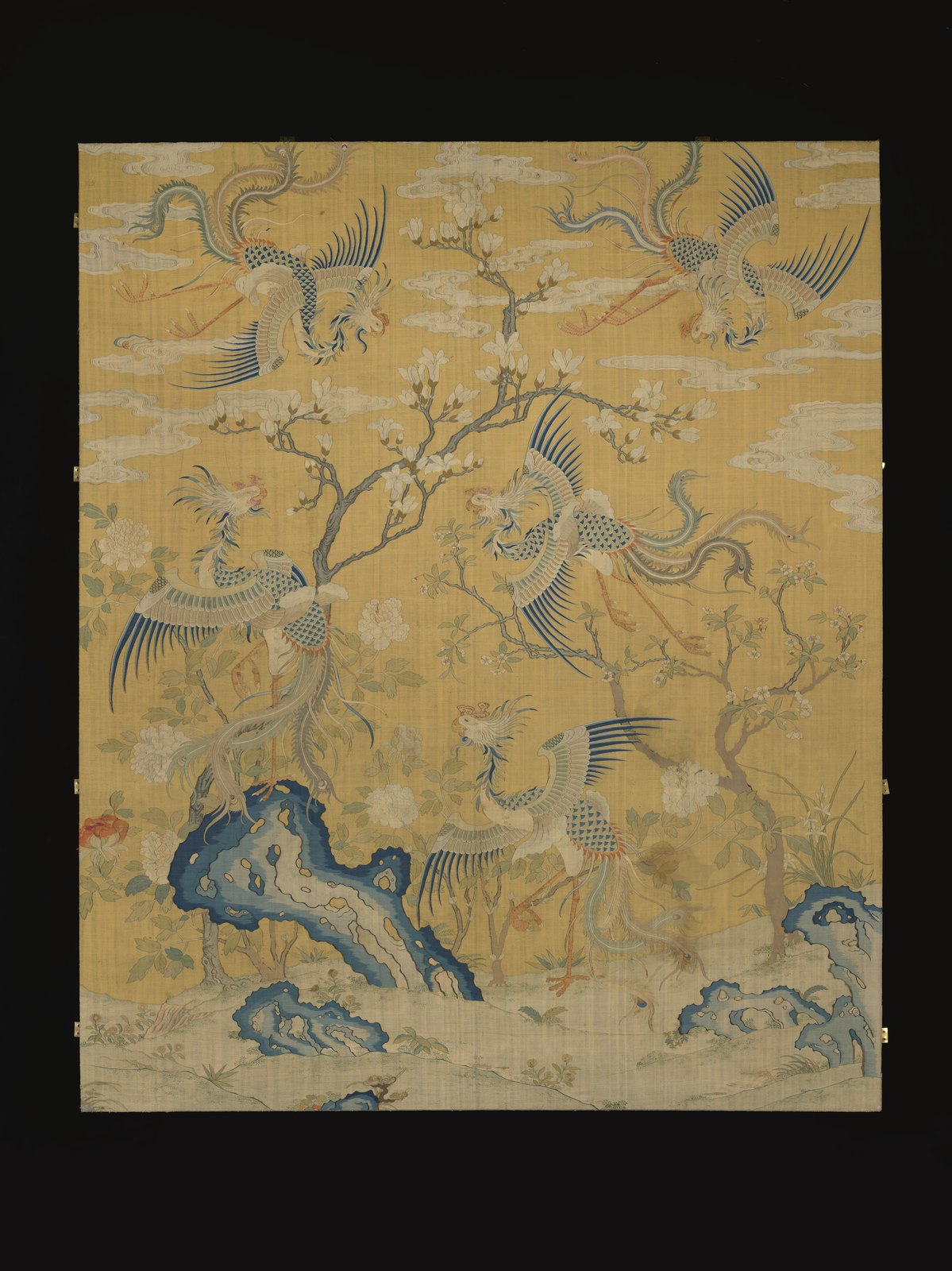
Begin with the large yellow silk panel. Count the birds: five. Two descend from the upper corners, one spreads its wings near the middle, and two stand lower in the garden. Their bodies combine sharp crests, layered wings, long curling tail feathers and slender legs. No living species supplies the complete anatomy. The pleasure comes partly from watching a woven creature remain legible while feathers change direction, overlap and dissolve into ornament.
Now follow the space between the birds. Pale clouds drift across the yellow ground. Branches divide the centre, flowers gather around rocks, and the open upper field lets the flying bodies feel suspended. The composition does not illustrate a chronological sequence. It distributes five separate bodies through one environment. That visual fact matters: before asking for a symbolic definition, we can say precisely how the image creates movement, distance and company.
This is also where close looking protects us from the rebirth cliché. There are no flames, pyre or emerging second life in the panel. That absence does not prove that every fenghuang story in every period excludes transformation; one object cannot carry that burden. It does show that fire is unnecessary for understanding this particular image. The woven garden gives us more immediate evidence than an imported legend does.
Peace, prosperity and an imperial setting
The Met places this eighteenth-century kesi in a court context associated with peace and prosperity. Its yellow ground, monumental scale and dense weave give that institutional setting a material form.
That careful framing matters. It links an association to a documented court object instead of announcing one timeless meaning for every bird called fenghuang. A motif on a tomb furnishing, a wedding charm or a modern logo would require its own evidence.
Court art often made order visible through animals, colours and materials. That does not mean each motif functioned like a word with one translation. It means that viewers learned to read combinations. For another example of birds carrying documented institutional information, compare Chinese rank badges, where species, textile and official setting work together. Context is not decoration around a symbol; it is part of the symbol's meaning.
The bird changes when the material changes
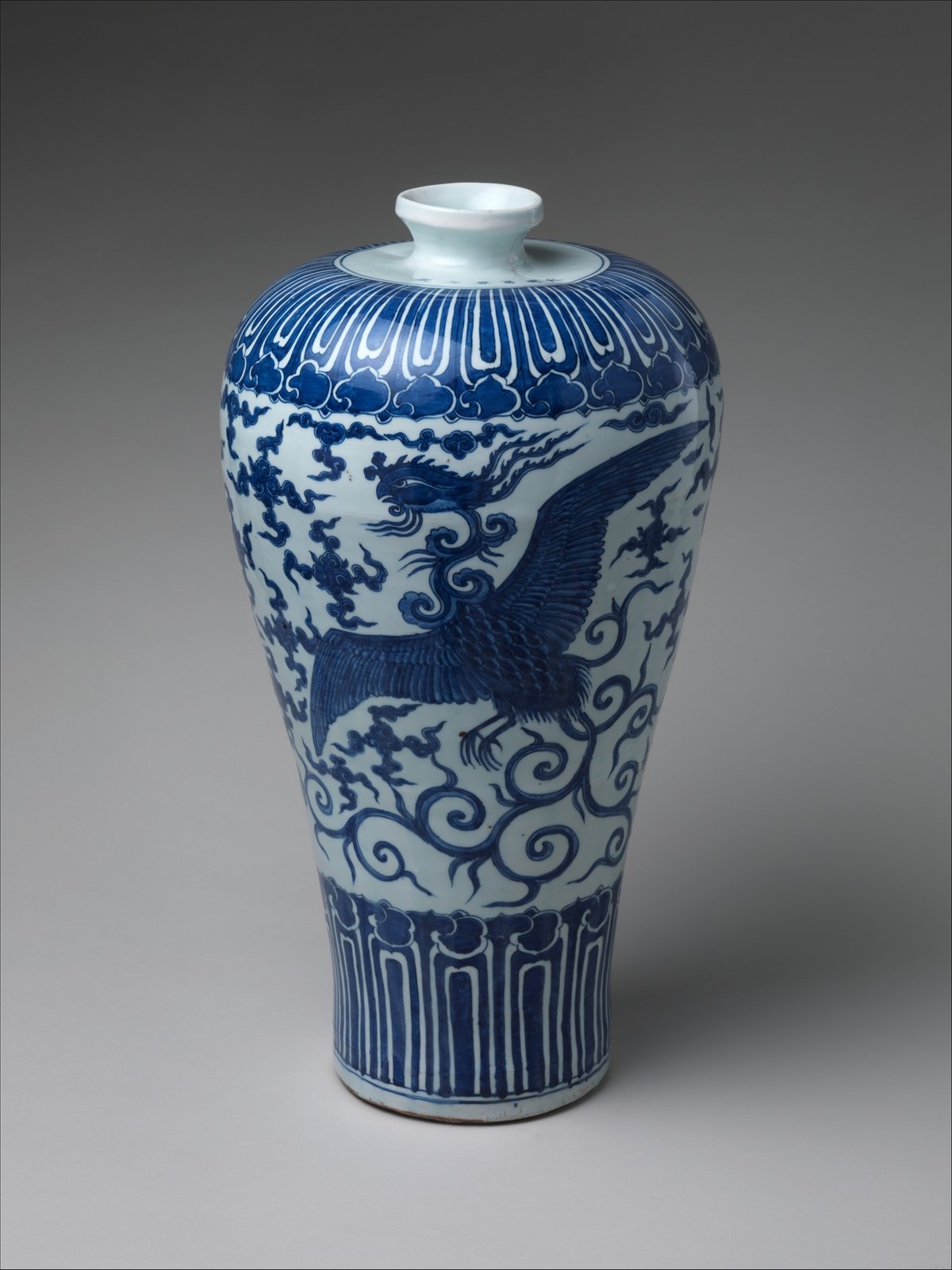
A late sixteenth- or early seventeenth-century meiping moves the fenghuang from silk to Jingdezhen porcelain. Cobalt blue under a transparent glaze reduces the palette but sharpens the relation between bird and empty white ground. One wing rises along the vase's shoulder, the beak points into a band of cloud scrolls, and the tail turns into curling lines that echo the surrounding vapour.
The shape of the vessel changes how the image can be seen. Unlike the flat tapestry, the meiping never offers its whole painted circuit from one viewpoint. A person must turn the vessel—or move around it—to follow the bird. The swelling shoulder gives the wing room; the narrowing lower body pulls the clouds into a different rhythm. If you want to understand the material history behind this palette, continue with blue-and-white porcelain. Here the essential point is that the same named creature becomes a different visual event when line, glaze and curved volume replace woven thread.
Dragon and fenghuang: read the pairing carefully
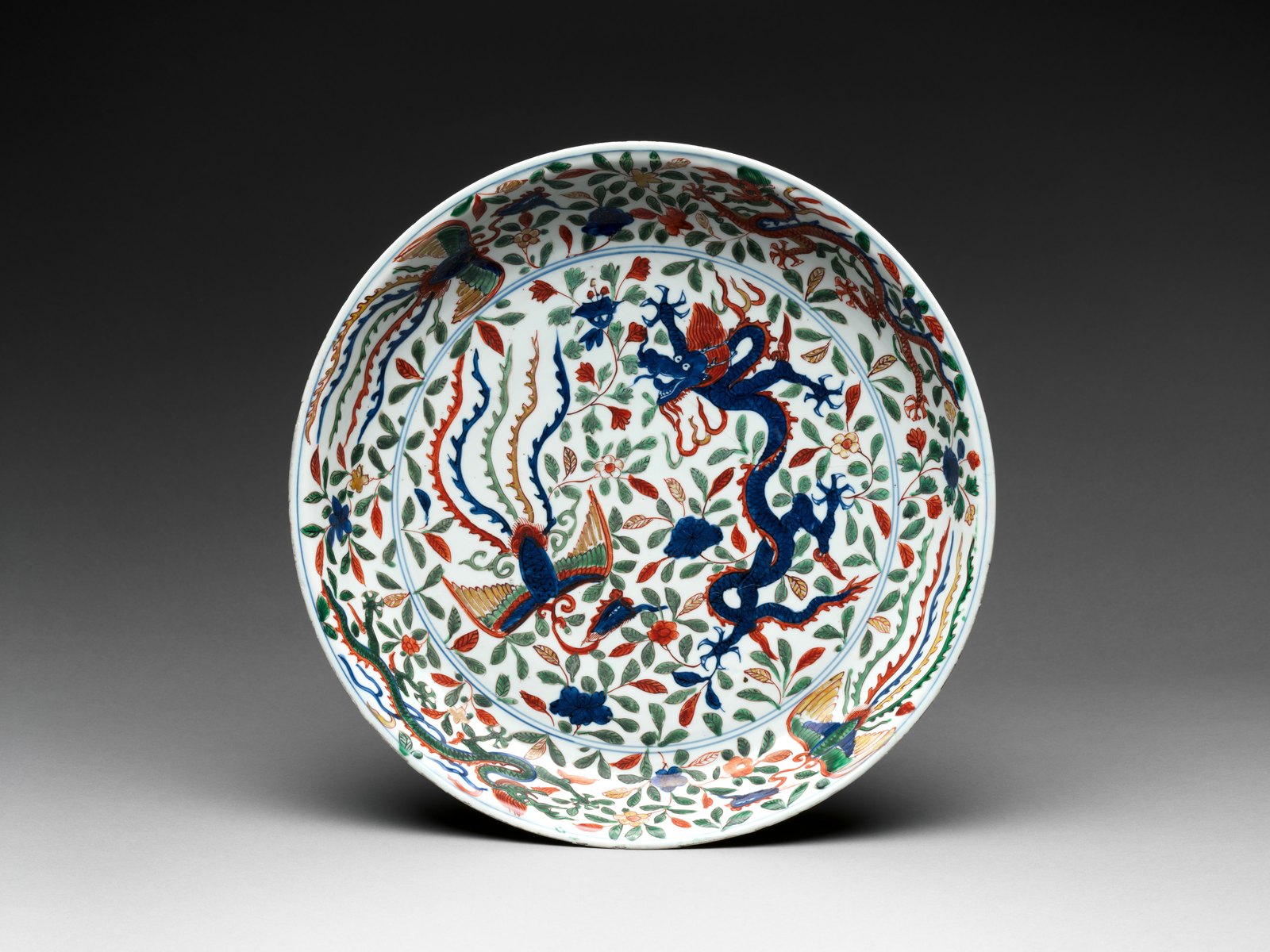
A Wanli-period dish with a dragon and phoenix adds another relationship. The blue five-clawed dragon twists through the centre while a long-tailed bird turns across the same field of flowering vines. Coloured enamels over the glaze bring red and green into the underglaze-blue structure. The circular dish makes the two creatures part of one rotating composition rather than isolated emblems.
The Met identifies the five-clawed dragon here with the emperor and says the phoenix was often associated with the empress. The word "often" deserves to stay. The record documents a real gendered reading for this particular court object, but it would become too broad if converted into a rule for every period and setting. A wedding inscription, a ritual context or a different patron could activate the pairing differently. The dish does not prove that every dragon is inherently male or every fenghuang inherently female.
The safer method is to ask what activates the pairing: an imperial mark, a wedding inscription, the building where an object was used, or a museum's documented provenance. Readers curious about the other creature can continue with why the Chinese dragon is not a Western dragon. In both cases, an English translation can suggest familiarity while hiding a different history.
How to meet the next fenghuang
When a museum label says "phoenix," keep the translation but test it against the object. First describe the creature without naming it: crest, beak, wings, tail, claws, direction of movement. Then record the date, material and setting. Finally, read what the collection says and notice the level of certainty. "Associated with" is different from "always means." A title supplied by a museum is a path into research, not permission to add every story attached to the same English word.
It is perfectly reasonable to write "fenghuang, often translated as phoenix." The phrase becomes accurate when the gap between the terms remains visible. For the three Chinese objects here, gardens, clouds, courtly order, imperial pairing and material transformation offer enough to explore. Fire and resurrection would not enrich the reading; they would replace the evidence in front of us.
The reward for slowing down is not merely avoiding a mistake. It is gaining several birds instead of one generic symbol: five woven presences in a vast garden, a cobalt body curving around porcelain, and a coloured partner circling a dragon. Translation opens the door. Looking carefully decides what comes through it.
Join the conversation
What did this make you notice?
When a familiar translated name is attached to an unfamiliar creature, what would you examine first: the object, its historical setting, or the story suggested by the translation?