
A closer look
A bird on an embroidered square may look like a decorative flourish. On an official's ceremonial clothing in imperial China, it could also tell you where that person stood within a hierarchy. Rank badges, commonly called buzi, made government visible through cloth. Their animals were not simply favorite creatures, and their miniature landscapes were not merely pretty backgrounds. Together, they created an image that could be admired as workmanship and understood as a statement of position.
The most rewarding way to approach one is neither to memorize every animal nor to treat the square as a mysterious code. Start with three questions: what does the museum identify, how was the object made, and what changes when a textile designed for a body hangs alone on a wall? Those questions allow beauty and history to remain in the same conversation.
A bird with an official role
In the Ming and Qing systems, birds generally distinguished civil ranks, while animals marked military ranks. The precise rules and designs changed over time. A crane could indicate the highest civil rank; the peacock was associated with the third. These are historical assignments within a regulated dress system, not timeless meanings carried by every image of those birds. A crane on a vase does not therefore turn the vase into an official badge. USC Pacific Asia Museum
That difference is useful far beyond this one subject. Chinese visual culture often places an image in several settings, where it performs different work. A bird can be observed from nature, admired for its feathers, used in an auspicious composition, or assigned a bureaucratic role. Before translating the motif, identify the kind of object carrying it. Context is part of the design.
Begin with one documented crane
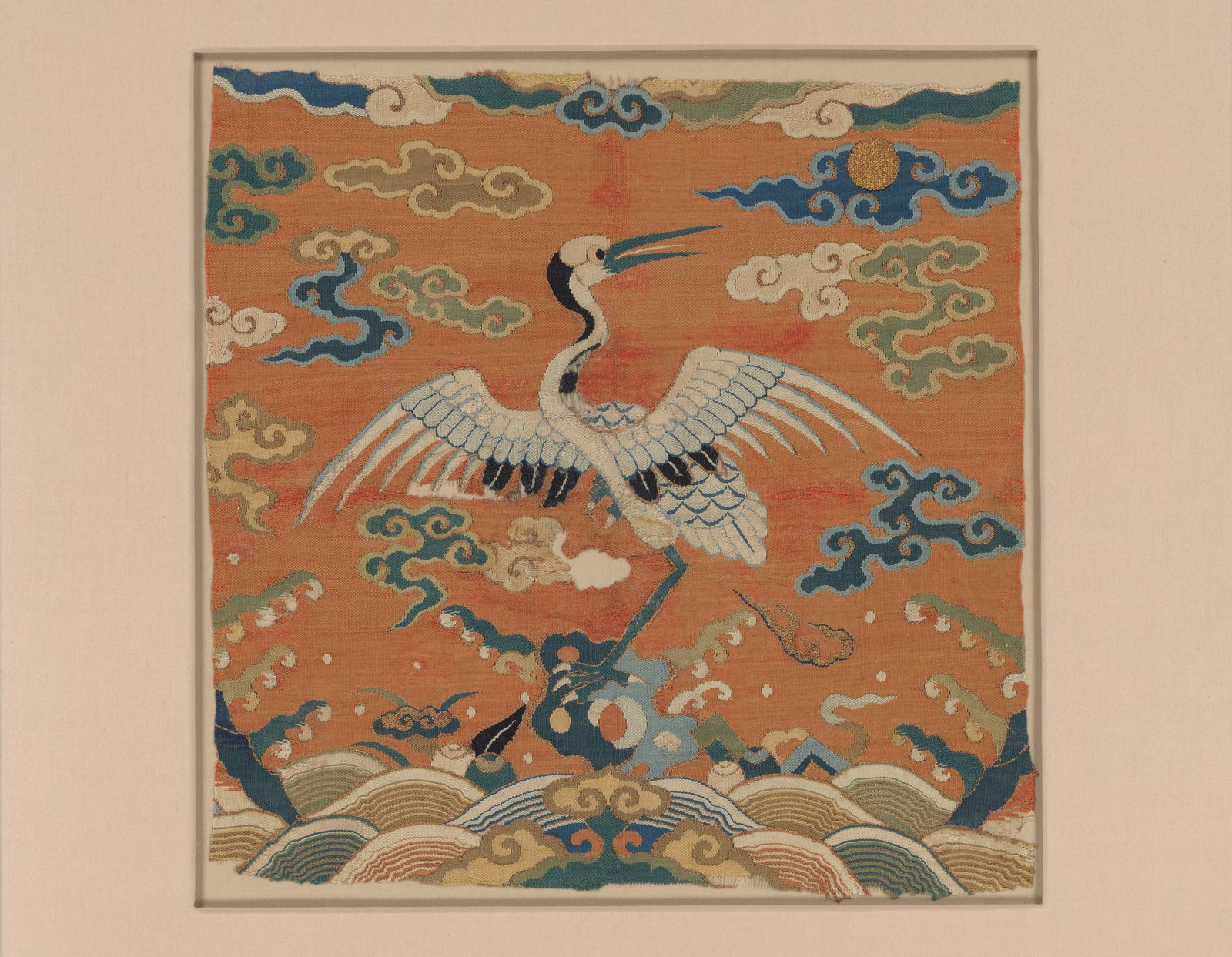
The Metropolitan Museum of Art holds a Qing badge from the Kangxi period, identified as a crane for a first-rank civil official. It is silk tapestry, or kesi, with metallic threads emphasizing details. The museum also identifies the sun at the upper right as a feature of Qing badge imagery. This particular object gives us a firmer starting point than an unlabeled photograph circulating online. The Met, 30.75.830
Look first at how much space the creature occupies. Then move outward toward the surrounding field. Your eye may initially register a single picture, but it is also following thousands of material decisions. Edges, changes of color and the handling of light create distinctions that a small screen can flatten. Magnification is helpful, provided we remember that enlarged thread is not the scale at which the badge originally met another person's eyes.
Silk does not behave like paint
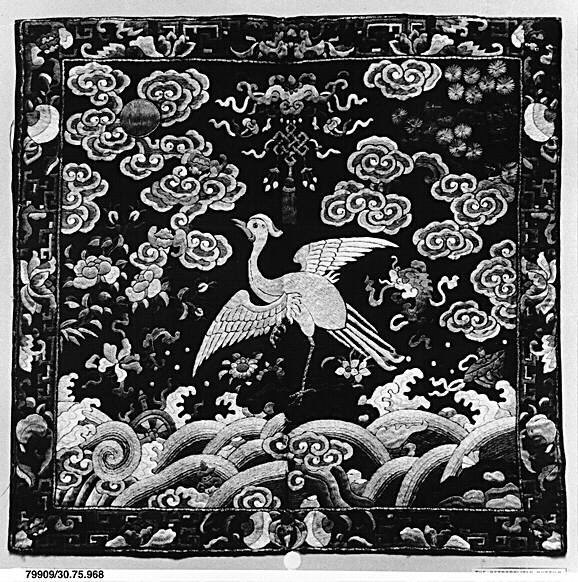
Two further Qing badges at the Met offer a useful material comparison. One, dated to the late eighteenth century, is catalogued as silk on silk; another eighteenth-century example combines silk and metallic thread on silk. Their records place them within embroidered textiles, unlike the tapestry-woven crane. The distinction is not a contest in refinement. It tells us to ask whether the image was constructed through weaving or added through stitching. Silk example, metallic-thread example
In a photograph, both methods can resemble a painted surface. Up close, they invite different kinds of attention. Follow a boundary rather than only a figure: how does one colored area meet another? Does a contour seem to float over the ground or belong to its structure? Such questions turn looking into an investigation of making. They also restore the labor that the badge's official message can overshadow.
A landscape worn, not entered
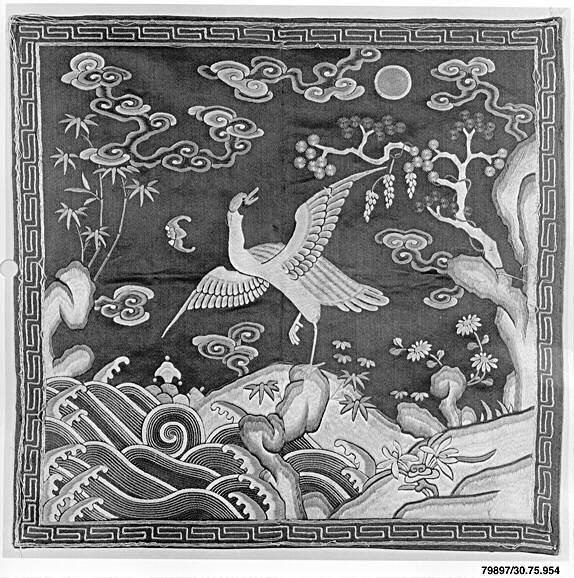
The landscape surrounding an emblem asks for a different kind of reading from a view of an actual place. It need not identify a mountain you could visit. Its task is to organize the creature within a convincing visual world. In many badges, the relationships between the central figure and surrounding elements are more important than any illusion of distance.
Try imagining the composition without its border. The picture would lose a powerful sense of enclosure. Put the border back, and the square becomes a compact field with its own internal order. This is an editorial way of reading the design, not evidence that every wearer explained it in those terms. It helps us see why the background deserves attention without assigning an unsupported symbolic definition to every curve.
Clothing complicates the museum view
A detached badge gives us unusually easy access to detail, yet hides the garment's movement and scale. We no longer see how the square sat against a larger expanse of cloth, or how a viewer's distance changed what was legible. It is worth resisting the temptation to imagine the museum photograph as the complete original experience.
Nor should we invent a particular official around an anonymous surviving textile. Unless a record supplies ownership, a badge cannot tell us whether its wearer was admired, competent or honest. The design announced status; it did not prove character. That separation between the claims of clothing and the conduct of its wearer remains one of the most interesting things about the object.
Let the image stay larger than its label
Knowing that a crane signals a rank is useful, but it is only the beginning. Once identification is complete, return to the image without testing yourself. Notice the proportion of bird to field, the rhythm of stitching and the balance between luminous and quiet areas. The textile rewards an attention that is slower than decoding.
This is also why old dress should not be reduced to a mood board for contemporary luxury. Its beauty belonged to institutions, hierarchies and skilled work. We can appreciate the workmanship while asking what the garment communicated and whom it excluded. The most engaging museum encounter holds those responses together: pleasure in the surface, curiosity about the system, and respect for what remains unknown.
Continue with Hanfu beyond the silhouette and calligraphy as visible movement.
Join the conversation
What did this make you notice?
What changes in your response to a beautiful textile when you learn that it also announced its wearer's rank?