
A closer look
Bats appear as auspicious motifs in Chinese decorative art because of wordplay: the fu in the Chinese word for bat sounds like fu, meaning blessing or good fortune. This is a relationship between language and image, not a claim that the animal has an inherently lucky nature. Once a maker turns the sound into a motif, a vessel can carry a message without spelling it out in a sentence.
For an international viewer, that possibility is often the surprise. An animal associated with darkness in one familiar visual tradition can do different work in another. But replacing “bats are frightening” with “Chinese people think bats are lucky” is still too broad. The more useful approach is to examine particular objects, their dates and the company their bats keep. Context turns a general association into something worth looking at closely.
A picture that asks to be heard
The USC Pacific Asia Museum's guide to symbols explains the sound connection and the group of five bats as a wish for five blessings: longevity, wealth, health, virtue and a peaceful death. The important starting point is not memorizing a list. It is recognizing that an image can operate through the ear as well as through the eye.
Such a construction is often called a rebus: things represented visually suggest words or sounds that create another meaning. You do not need to know every association before enjoying an object. Yet one small piece of linguistic information can change your attention. A creature that looked like background decoration becomes a participant in a message. The surface is still beautiful, but it is no longer only a surface.
There is a caution here for translation. An English label cannot reproduce the sound relationship simply by placing “bat” next to “blessing.” Neither can a Spanish label by pairing murciélago with bendición. The explanation has to carry what the translation loses. That does not make the design inaccessible. It shows why good cultural interpretation sometimes needs a short explanation rather than a supposedly universal symbol.
Follow the bat around the vessel
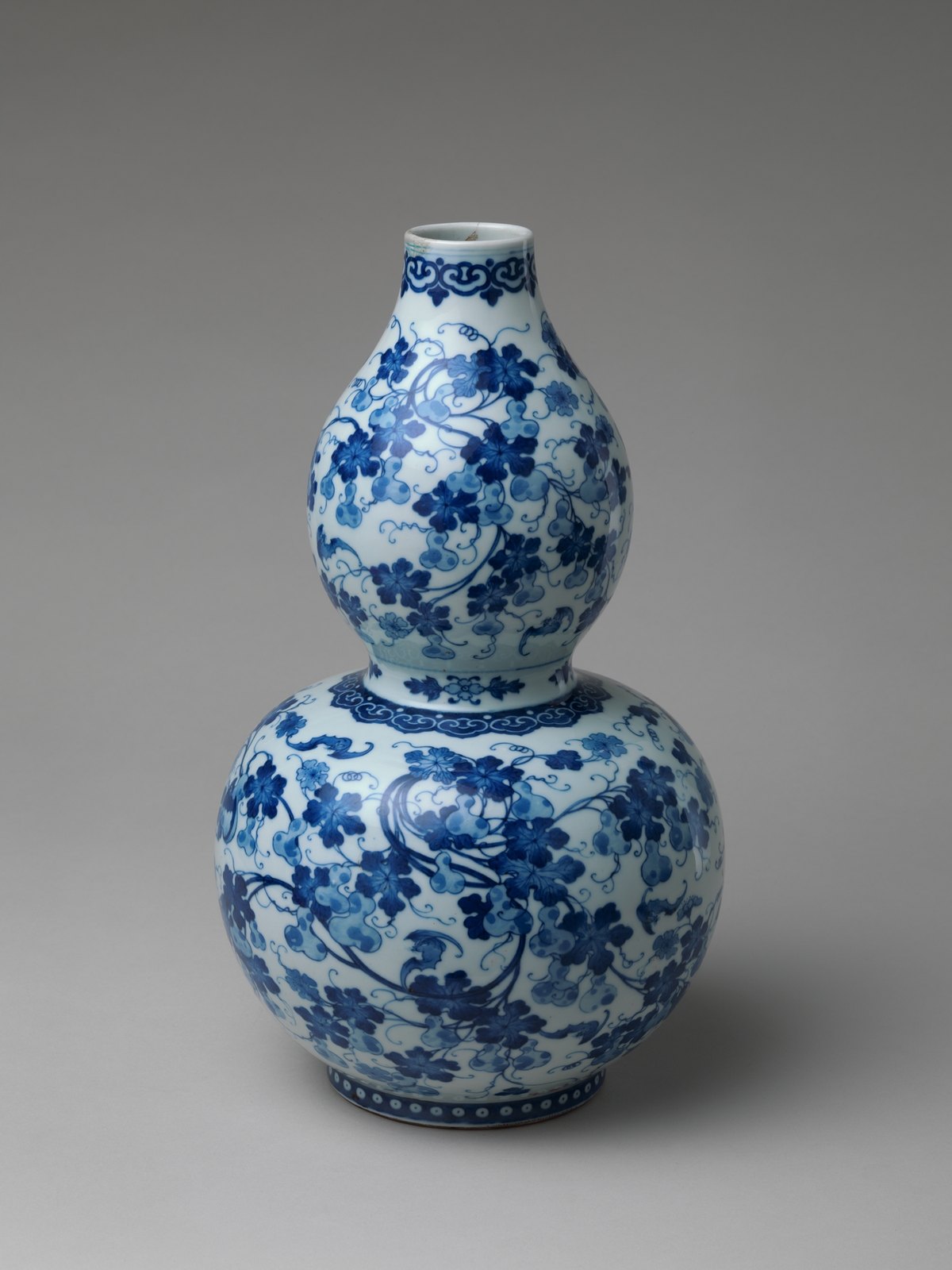
The Met's gourd-shaped vase with gourds and bats, made in the early eighteenth century, combines its shape with painted motifs. The museum reads the ensemble as an auspicious visual puzzle conveying fortune and prosperity. It is porcelain decorated in underglaze cobalt blue: an object whose material, contour and imagery all contribute to the experience.
Begin by looking at the outline before identifying the painted creatures. The swelling body and narrow passages make your eye move differently from the way it would across a flat rectangle. Decoration inhabits that changing surface. In a photograph you see one orientation; the object continues beyond it. This is why an isolated motif extracted from the vase tells only part of the story.
Then return to the bats. Ask how their wings interrupt or echo the other forms, where they appear relative to the vessel's curves, and whether the image invites your eye to travel. These are visual questions you can answer without claiming to decode every detail. Knowing the auspicious association should deepen observation, not replace it with a quick label and permission to stop looking.
A dish can hold more than one kind of attention
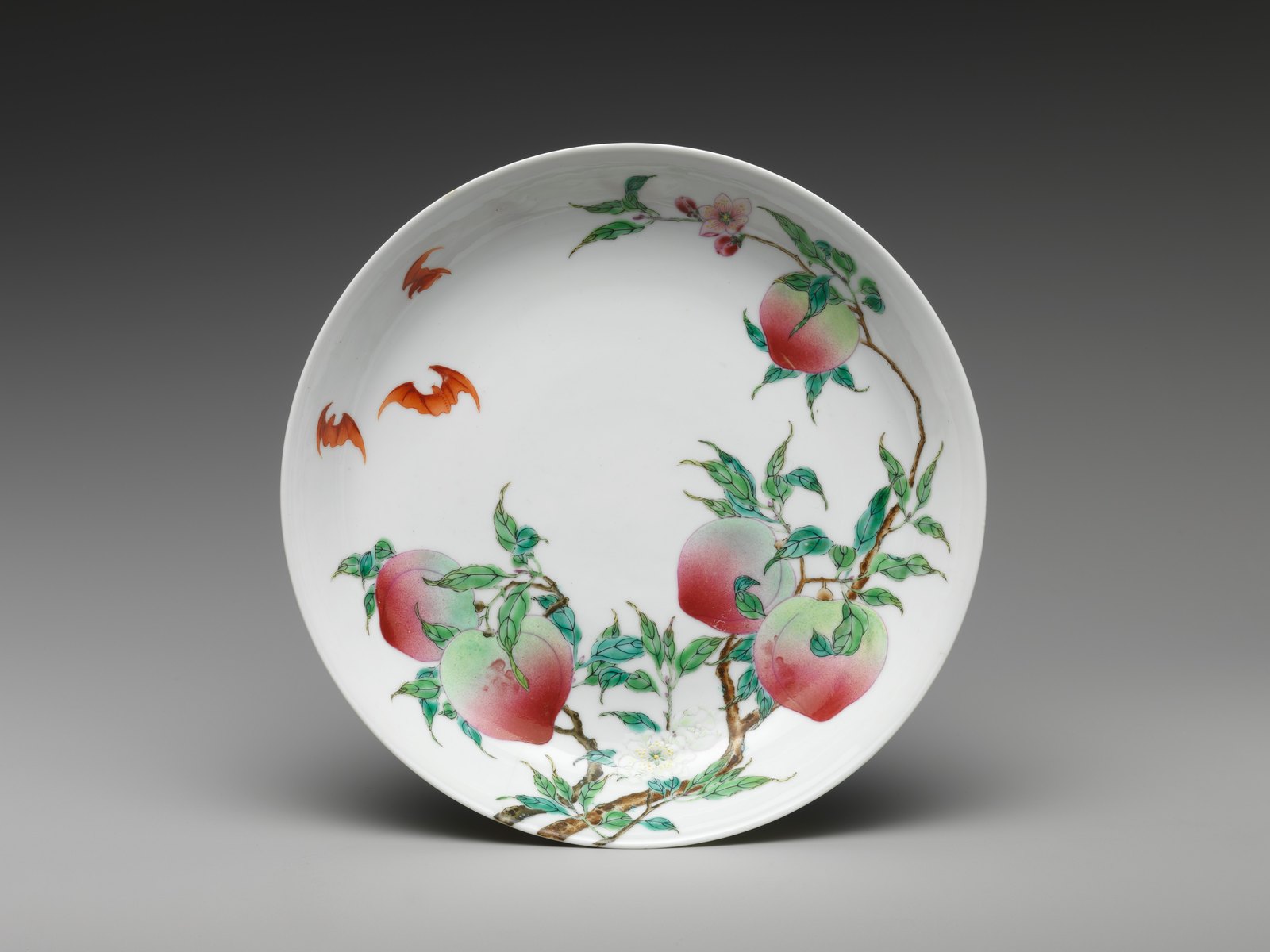
The dish with peaches and bats at the Met belongs to the early eighteenth century and is decorated with overglaze polychrome enamels. Its record explains that the pink colour involved a technique introduced through Europe and adopted in imperial workshops. A design can participate in a Chinese auspicious vocabulary while its making also belongs to a history of technical exchange.
That combination disrupts a familiar but unhelpful division between “traditional meaning” and “foreign influence.” Objects do not always respect our categories. We can ask what the motif communicates and how the colour was achieved without forcing those questions to compete. A surface can be culturally specific and materially connected to developments elsewhere at the same time.
The dish also asks for a different viewing pace from the vase. Trace the composition across the available white surface. Notice the relation between concentrated colour and areas left comparatively open. Try looking once without naming anything, attending only to colour and direction; then look again with the title in mind. The second viewing should add to the first, not erase the pleasure of seeing before decoding.
Repetition changes the composition
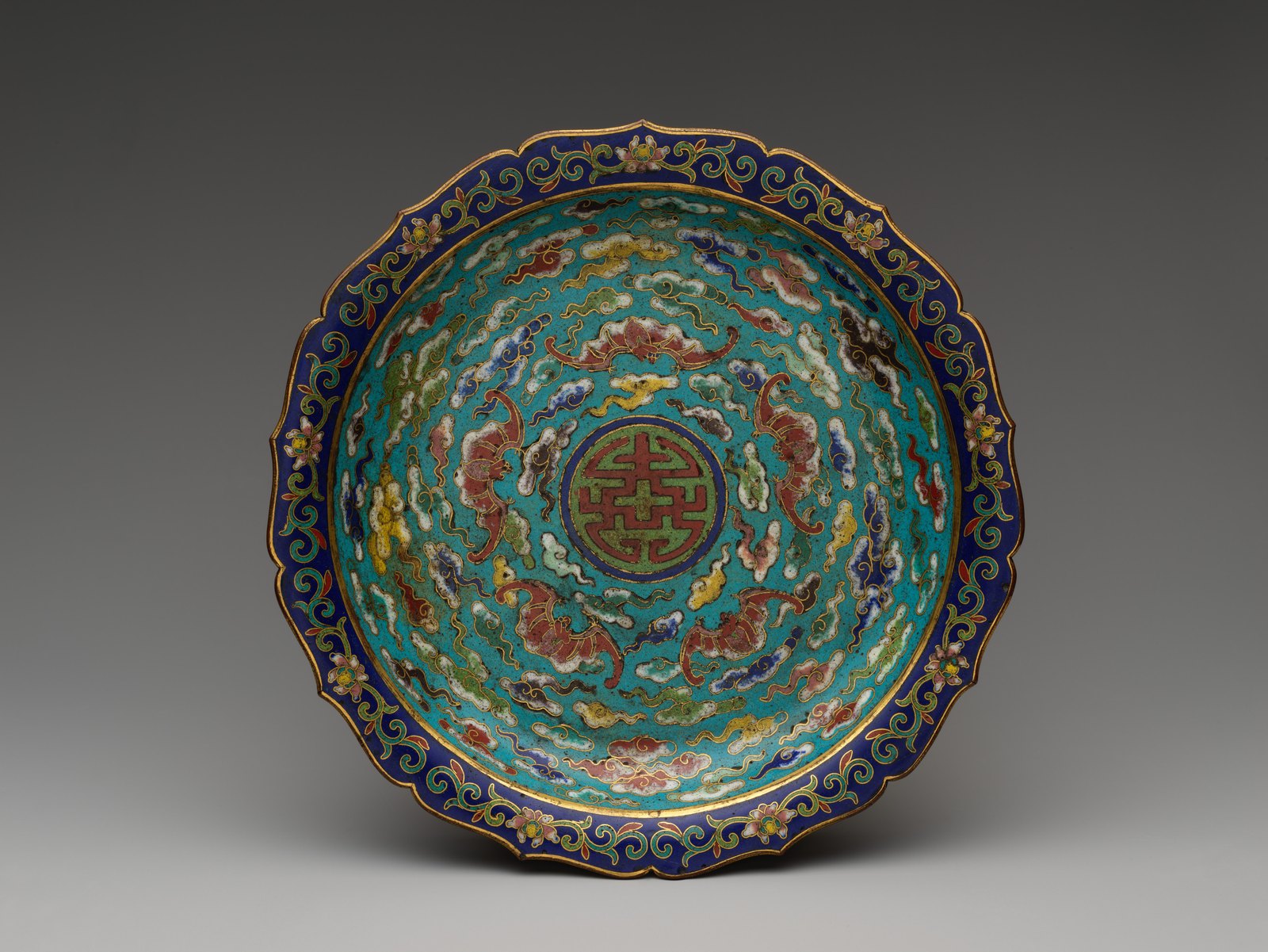
A later object, the Met's foliated dish with bats amid clouds, uses cloisonné enamel rather than porcelain. Its late-eighteenth-century date and different medium matter: the three objects shown here are examples from a particular historical range, not a timeline of every bat image made in China. Their shared motif gives us a way to compare without making them identical.
Count and arrangement deserve attention, but do not begin by assuming that every group must illustrate the same formula. Look at where the forms point, how the edge contains them and how repeated curves organize the surface. A symbol does not exist independently of design. Even when two objects use a comparable visual vocabulary, differences in rhythm and placement change the experience of reading it.
Five-bat compositions can invoke the five blessings described above. That does not mean the number five on any Chinese object automatically carries the same meaning. The design needs to support the interpretation. This distinction is especially useful online, where a cropped detail can travel far from its original object and caption. Always try to find the whole work before confidently explaining the fragment.
A wish is not a guarantee
Auspicious imagery can be understood as an expression of hope. A wish for well-being does not require us to claim that the owner expected a decorated vessel to control the future. Nor does the presence of a bat motif tell us how every person in a household understood it. The surviving object gives evidence of a design and its cultural vocabulary, not unrestricted access to private belief.
Keep the difference between image and animal equally clear. Understanding an artistic association does not create a rule for approaching wildlife. This article concerns representations on objects. It is not a guide to handling bats or a claim about their behaviour. That boundary may sound obvious, but it helps prevent the attractive shorthand of symbolism from becoming misinformation about the living world.
Continue with the Chinese dragon or the relational language of red envelopes. Across these examples, the productive question is not “What does China believe?” but “What is this particular image or gesture doing here?” A bat can be a blessing because a culture gives sound a visible form. Looking carefully means keeping both the invention and its context in view.
Join the conversation
What did this make you notice?
Is there an animal or object whose meaning changes dramatically between cultures you know?