
A closer look
The rabbit in the Chinese moon is often busy. Instead of simply sitting beside the goddess Chang'e, it works with a mortar and pestle, preparing the elixir of immortality in a familiar strand of the story. That activity is the useful starting point: the Jade Rabbit is not only a lunar mascot. Its gesture gives a distant celestial place something almost domestic—a task, a tool and the suggestion of work continuing beyond human time.
There is no need to combine every version of the legend into one official plot. Nor does every rabbit in Chinese art automatically represent the moon. A more reliable way to recognize this particular animal is to look at its company, its tools and its setting. Three museum objects show how much can change while the lunar association remains legible.
A mirror offers a small lunar world
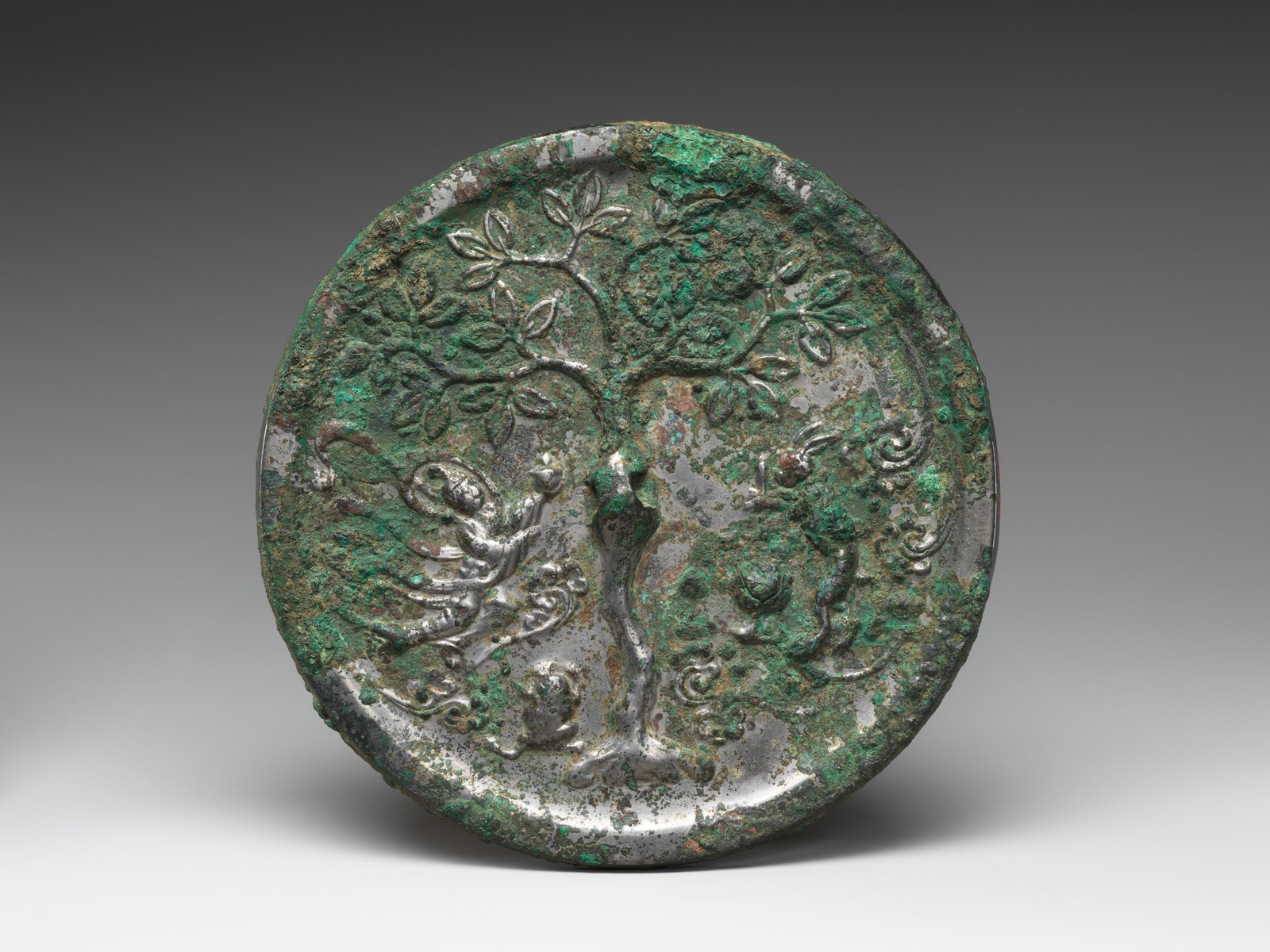
On the decorated back of an eighth- or ninth-century bronze mirror, the Metropolitan Museum of Art identifies Chang'e, a toad and a rabbit grinding the elixir with a pestle and mortar. The record relates one version of Chang'e's ascent to the moon. The object is evidence that this constellation of figures was represented in the Tang period; it does not by itself establish the story's first appearance. The Met, 25.24
The distinction between an object's date and a legend's beginning is easy to lose. “Ancient” can become an all-purpose label that makes different centuries seem simultaneous. Here, the dated mirror gives us something more precise: a surviving representation made within a particular period. The larger question of textual origins requires its own evidence and should not be answered merely by pointing at the oldest image in a small selection.
Watch the action before naming the animal
A rabbit beside a mortar communicates differently from a rabbit alone. The tool creates a relationship between figure and action. Even when the surrounding narrative is unfamiliar, we can notice that the animal is doing something rather than being displayed as an emblem.
This is a good exercise for looking at mythological art. Begin with the verb. Is a figure carrying, offering, holding, grinding or approaching? The action may provide a more useful clue than a generalized list of symbolic meanings. In this case, the grinding connects the rabbit with preparation. The museum's identification supplies the further step: what is being prepared belongs to the mythology of immortality.
That does not make the image a recipe, a medical recommendation or evidence of a substance's effects. The elixir belongs to the story. Keeping that boundary clear allows the scene to remain imaginative without presenting mythology as a promise.
A rabbit can identify someone else
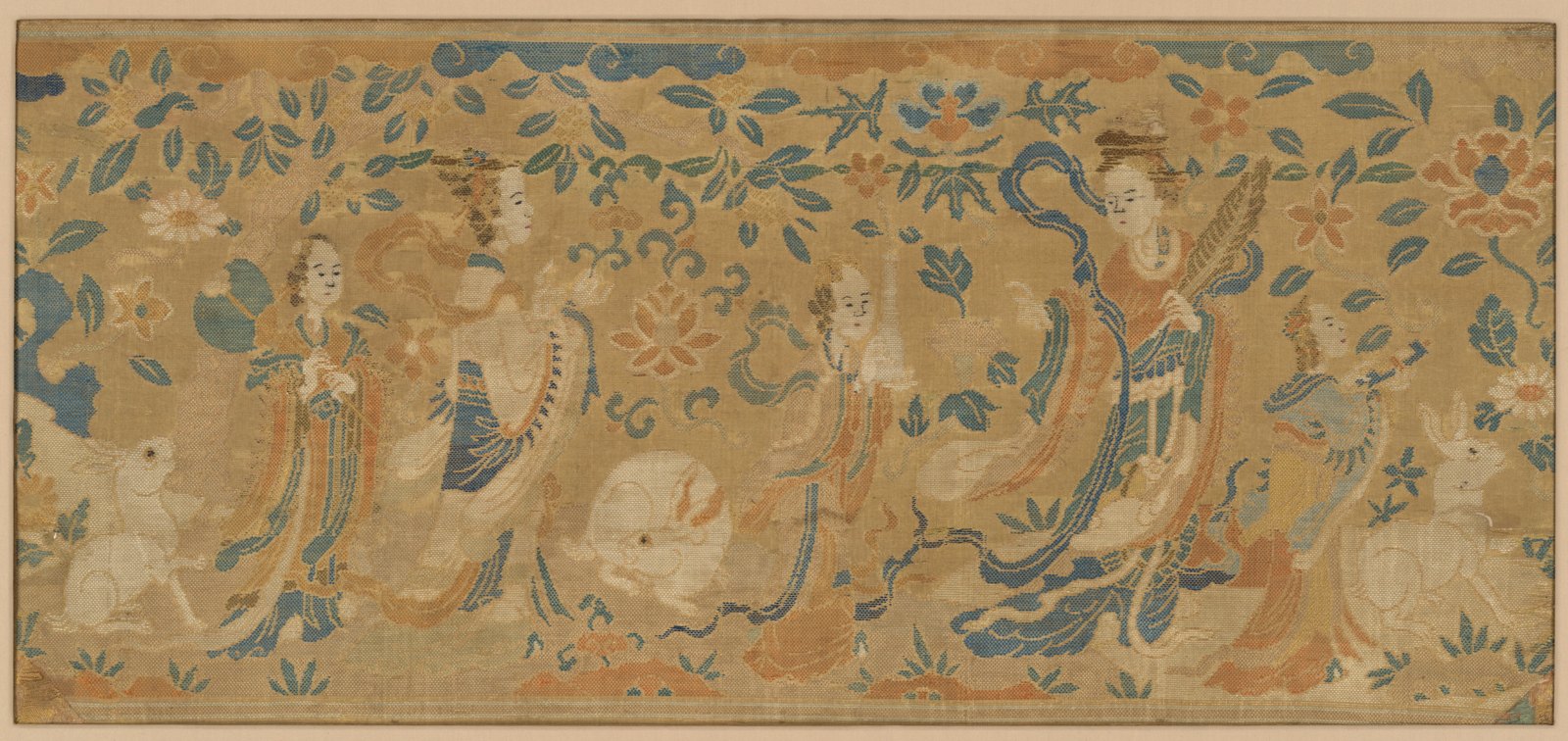
In a fourteenth- or fifteenth-century brocaded panel, the Met identifies a celestial garden with Chang'e and attendants. Rabbits near her feet and an osmanthus branch help establish the goddess's identity. The animal's role here is not identical to the mirror's working figure: it also helps the viewer recognize the surrounding scene. The Met, 46.156.25
This is one reason a cropped detail can mislead. Remove the rabbit from its setting and the image becomes a small animal illustration. Remove it from the goddess's surroundings and one of the identifying clues disappears. The complete composition preserves relationships that an attractive close-up may lose.
A visual essay should therefore show the whole object before inviting a closer look. The detail can reward attention, but it should not replace the context that makes the detail meaningful. This applies as much to a small phone screen as to a museum display.
The lunar setting can hold earthly ambition
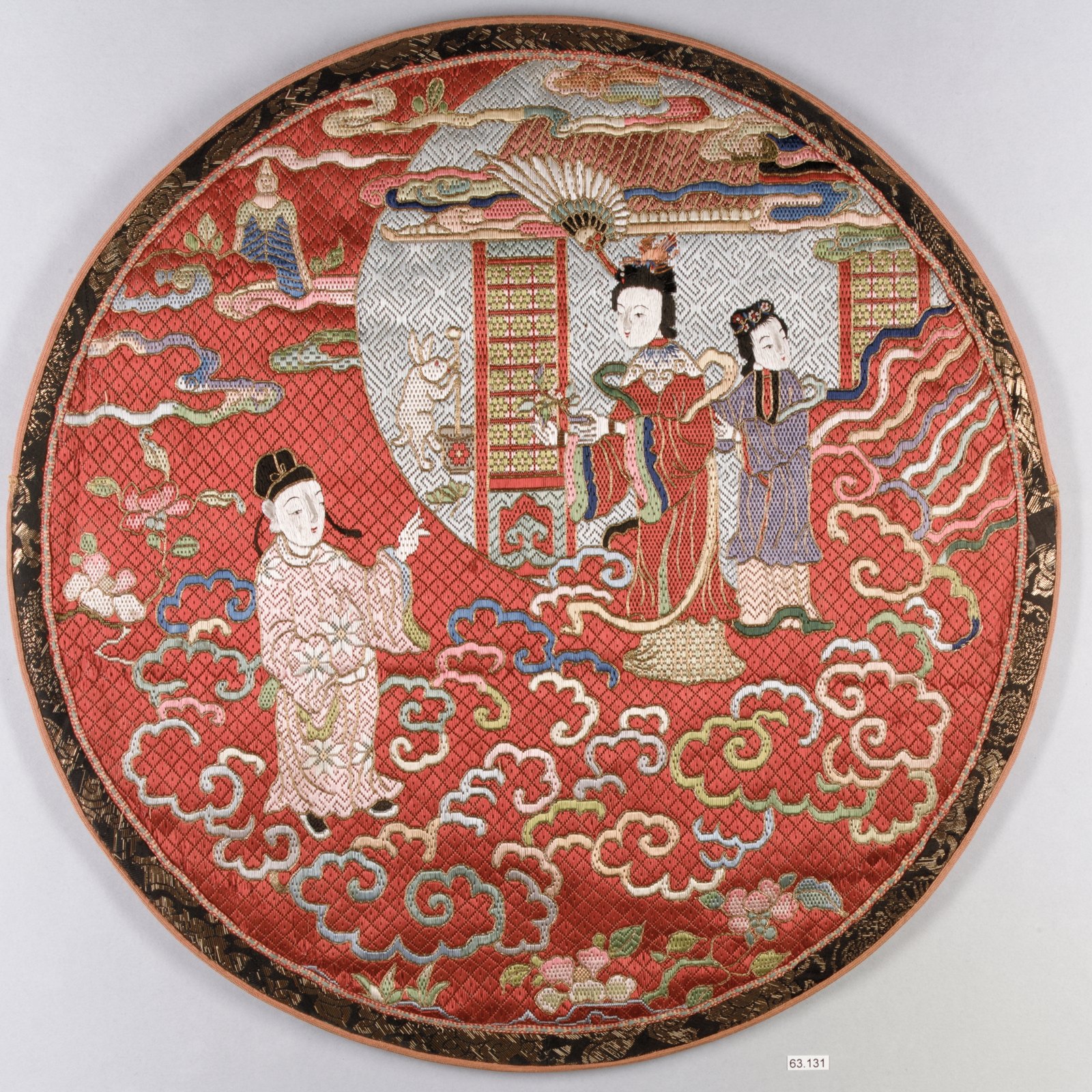
A nineteenth-century embroidered mirror case presents another turn. Its museum record connects the lunar osmanthus branch with success in the civil examinations, and identifies Chang'e handing a branch to a successful scholar while accompanied by an attendant and rabbit. The moon here can accommodate an earthly hope for advancement. The Met, 63.131
The rabbit has not ceased to be lunar because the scene carries another concern. A familiar setting can host different desires. This is more interesting than treating every appearance as an illustration of one fixed bedtime story.
For an international reader, the example also complicates the assumption that a mythological image must be purely religious or purely decorative. An object may invite several kinds of response. Its imagery can be recognizable, pleasing and connected with aspirations at the same time. The museum identifies this particular association; it does not tell us what every person who saw the textile felt.
Yutu travels from narrative to engineering
The name Yutu means Jade Rabbit. In January 2019, the China National Space Administration announced the name Yutu-2 for the rover carried by Chang'e-4, explicitly explaining the connection to the lunar rabbit. A technological mission borrowed a familiar cultural name, rather than requiring the old story to describe the machinery literally. CNSA naming announcement
That movement between contexts is worth noticing. A name can connect an unfamiliar undertaking with a recognizable imaginative world. The connection is cultural, not evidence that myth anticipated a technical design. Nor is this historical naming announcement a source for the rover's present operational status.
The two meanings can coexist without confusion: a story has its own kind of life, and an engineering project has measurable tasks. The shared name gives people a bridge between them. It does not erase their differences.
Return to the moon with a more specific question
For the wider festival setting, read our Mid-Autumn introduction. The rabbit is one path through that landscape, not a substitute for its many regional practices and family experiences. It also should not be confused automatically with the rabbit's separate place in the Chinese zodiac.
The next time you see a lunar rabbit on packaging, in a museum or in a children's illustration, ask what it is doing. Does the artist preserve the mortar? Place it beside a goddess? Let it become an independent character? Those small decisions show how a tradition is being retold.
A legend remains engaging not because all its images agree, but because looking carefully reveals their differences. The busy rabbit gives us a particularly gentle invitation: begin with one small gesture, and let the surrounding world become visible.
Join the conversation
What did this make you notice?
Which detail makes a myth feel memorable to you: a character's appearance, a particular object or something the character keeps doing?