
Begin with the edge, not the subject
Chinese fan painting brings pictures and writing onto a surface shaped for a handheld object. A rounded silk fan and a folding paper fan offer different spaces to compose within; the three Met paintings examined here are now mounted as album leaves. To understand them, look at the contour as carefully as the flowers, landscape or inscription. The shape is part of the work, not packaging around it.
A rectangular reproduction can obscure that distinction. On a screen, every image arrives inside the same luminous box. A fan asks you to notice the boundary inside that box: where the picture narrows, where it swells and where a curved edge refuses the expected corner. An artist cannot simply continue a branch wherever there is room in a rectangle. The available space keeps changing.
This is an invitation to look, not a rule that explains every Chinese fan. The examples here belong to particular makers and periods. They are useful precisely because they solve the problem differently, giving us something more concrete than a single symbolic meaning for the fan.
A rounded surface can hold a sudden encounter
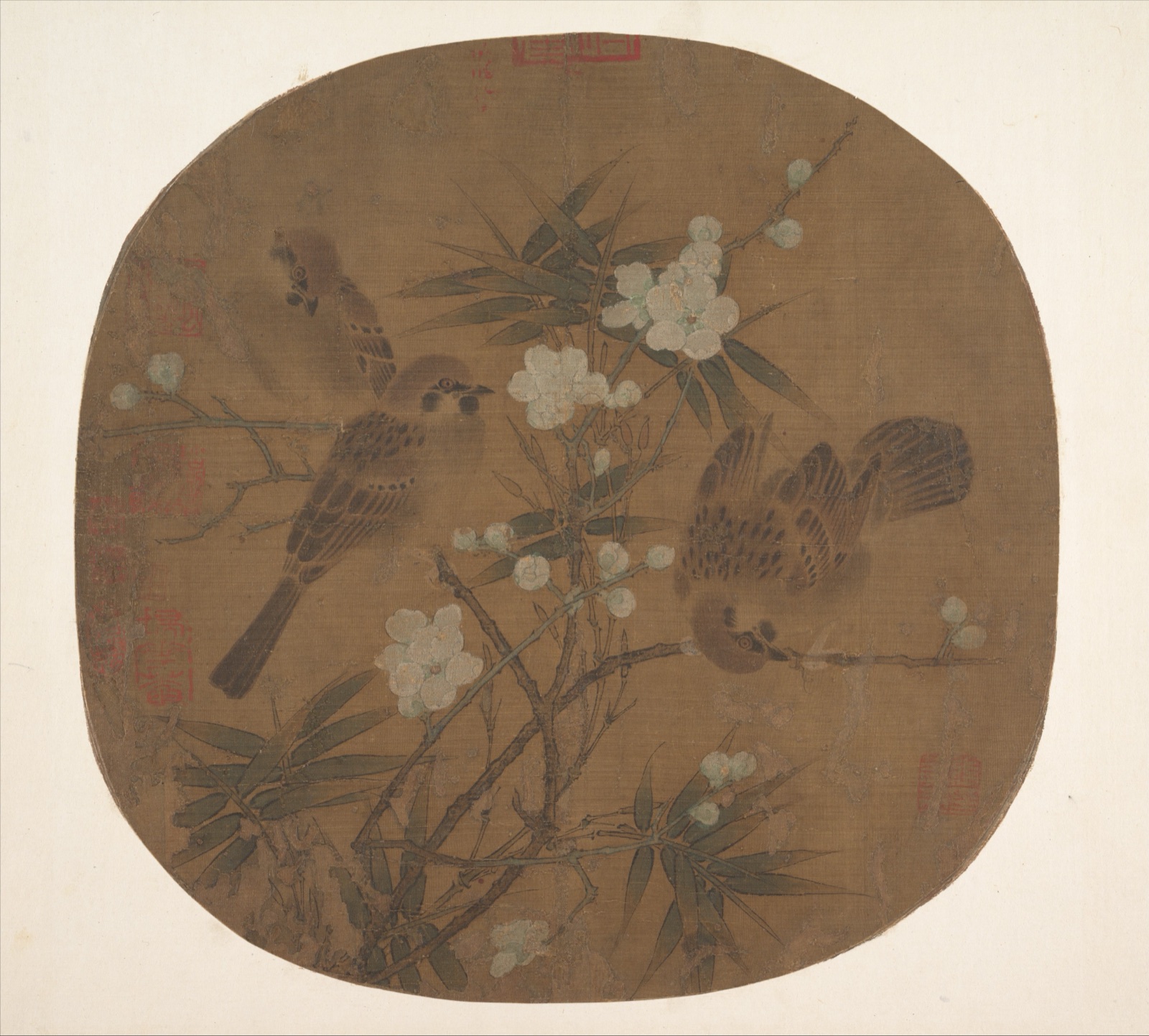
The Metropolitan Museum of Art dates Sparrows, plum blossoms, and bamboo to the late twelfth century. Its unidentified artist worked in ink and color on silk; the fan is now an album leaf. The picture gives us no sweeping landscape. Instead, three birds, pale blossoms and pointed leaves occupy a close, rounded field.
Follow the birds before trying to identify every plant. One bird stretches downward at the right, another faces across the middle, and a third tips its head from above. Their different orientations create small changes of direction. The blossoms provide pale stopping points, while the dark bamboo leaves make sharper interruptions. The eye can circle without encountering a rectangular corner that tells it to turn.
This reading does not require the birds to stand for an abstract virtue or the flowers to supply a secret code. Start with the visible arrangement. A leaf can matter because it is narrow beside a rounded blossom; a bird can matter because its body reverses another bird's movement. Meaning may begin with these relationships before it needs a dictionary of symbols.
A lake unfolds across a narrow arc
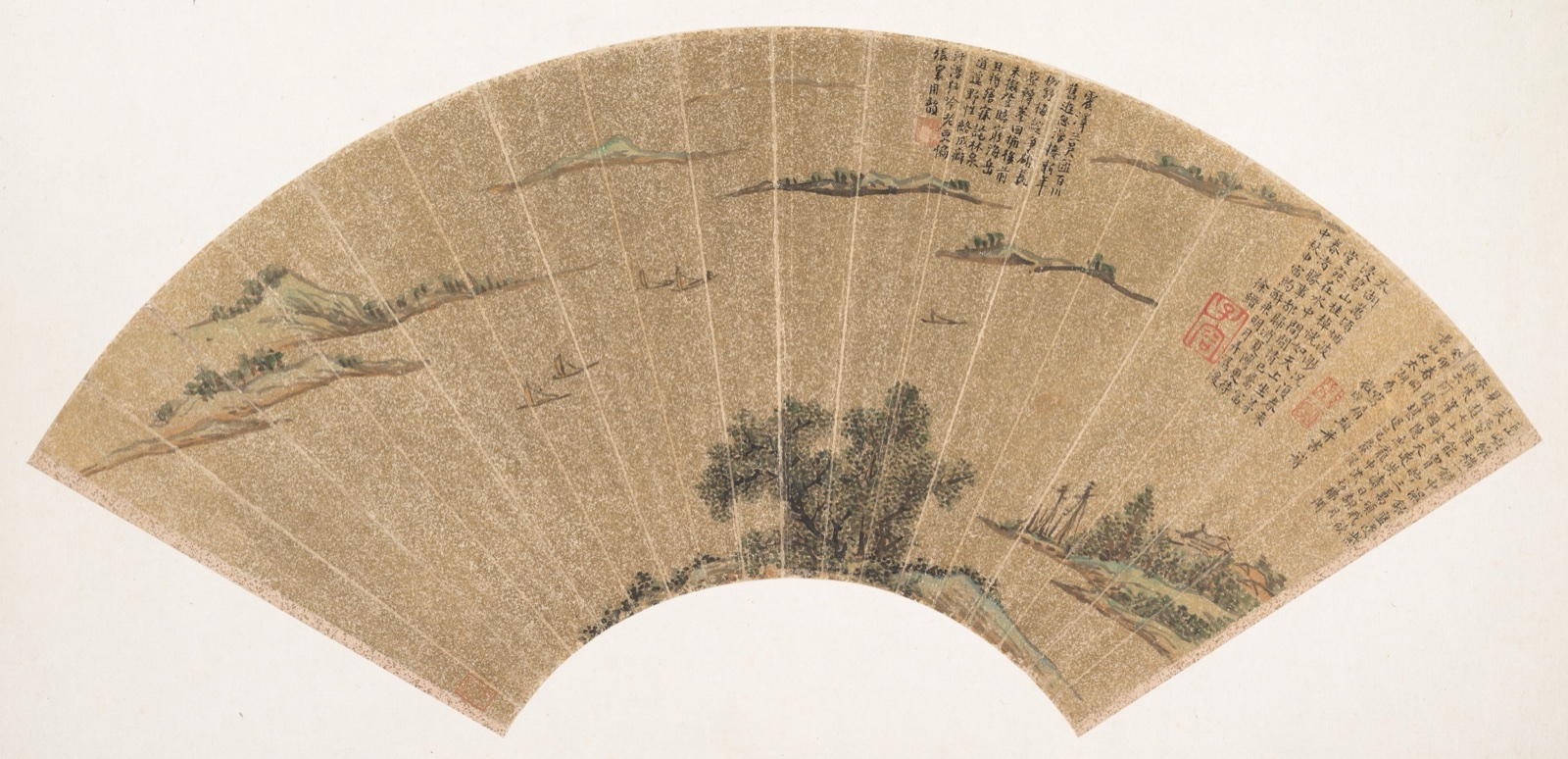
Wen Zhengming's View of Lake Tai, dated 1543, takes a different approach. The Met identifies it as a folding fan on gold-flecked paper, later mounted as an album leaf, and connects its making to a boat outing with a friend. The curved surface contains islands, trees, boats and writing rather than a single central spectacle.
Look at the water between those elements. It does not have to be filled with waves to suggest distance. Small boats interrupt an expansive gold-toned interval; thin islands reach horizontally across it. Near the lower edge, trees feel close and dense. Higher up, small landforms become more detached. The fan's outline remains insistently present, yet the space inside it seems to exceed its small physical dimensions.
The inscriptions also occupy the composition. Even without reading them, you can compare their compact, slanting groups with the more open stretches of water. This is a useful companion to looking at empty space in Chinese landscape painting: an interval gains its character from what stands beside it. Here, paper, writing and landscape remain visible together.
The mechanism belongs to the picture
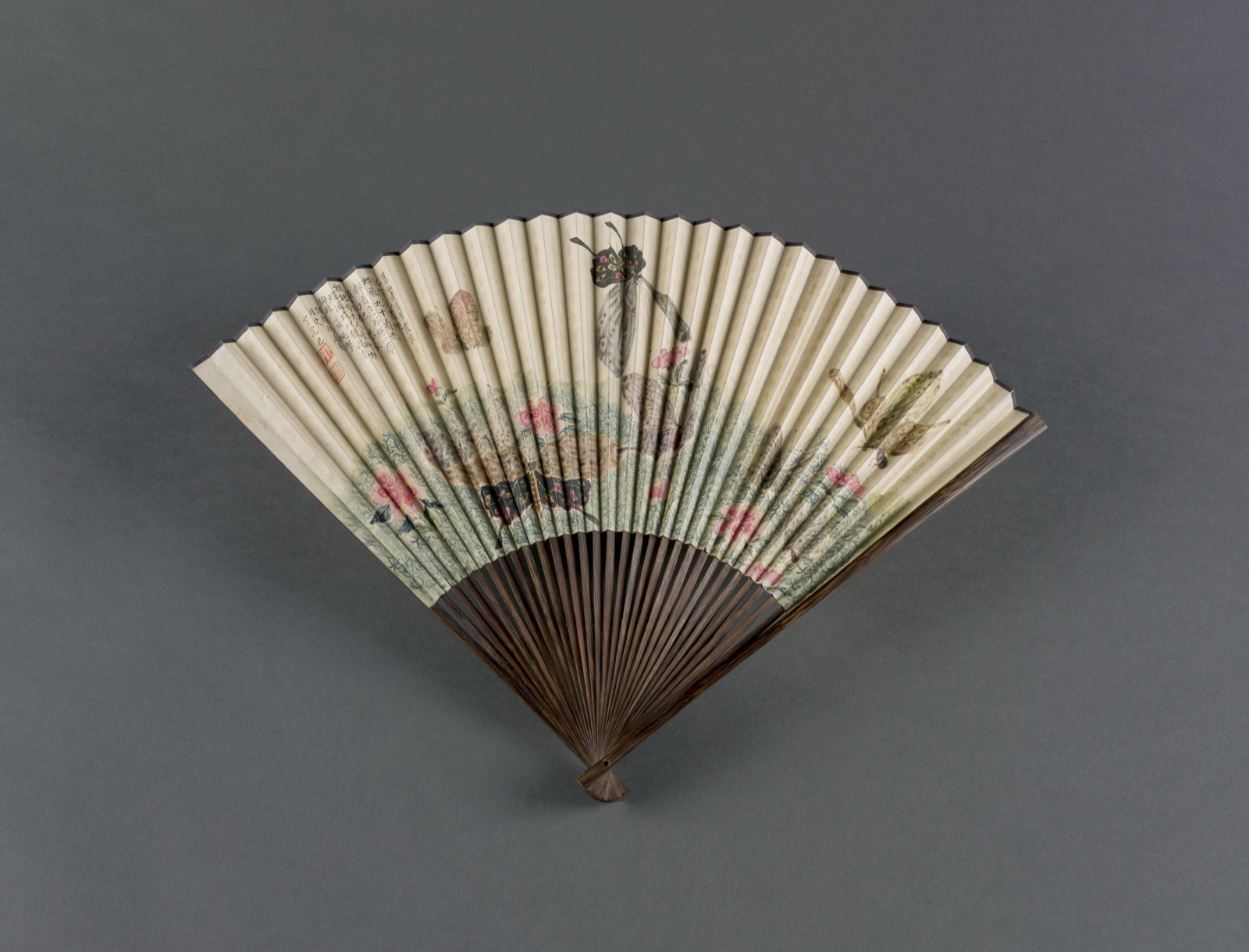
A fan dated 1869 at the Saint Louis Art Museum retains bamboo ribs. The museum records two paper surfaces, with painting on one side and calligraphy on the other. Its outer guards enclose twenty-eight thinner ribs. This object makes something obvious that an album leaf can hide: the image once belonged to a constructed, movable support.
Opening and closing such a support changes how much of its surface is available to see. That does not establish how any particular owner used this historical fan, but it changes the question we ask of it. Instead of considering only what is depicted, we can ask how the object offers, conceals and reoffers a picture. Its closed outline and open silhouette are very different designs.
The two sides complicate the encounter further. Turning an object is not the same as scanning a wall label. Painting and calligraphy can each ask for attention without being visible simultaneously. The construction makes looking an action, even when a museum photograph necessarily holds that action still.
Refinement did not exist outside commerce
A fan painting need not be imagined only as an intimate gift between friends. In its account of Hu Yuan's Landscape, the Met describes artists advertising commissions through fan shops, mounting shops and stationery shops in nineteenth-century China. The painted fan could belong to a commercial setting as well as a personal exchange. Neither context automatically tells us how carefully a work was made.
Hu's fan also offers a useful visual contrast with Wen's. In the museum image, dark clusters of trees and mountain ridges occupy much more of the available arc. A small boat and a pale passage at the right briefly open that density. Put the two records beside one another and compare how your attention moves. Does it skim across separated islands, or search through overlapping masses? The format supplies a shared constraint, not a single style. A fan-shaped picture can be spacious, crowded, delicate or forceful without ceasing to work with the same curved boundary.
An album preserves the image and changes the encounter
All three Met records identify their fan paintings as mounted album leaves. The designation matters. What survives for us to study is not necessarily an intact object ready to open in the hand. We should not mistake a surviving painted surface for complete evidence of its original handle, supports or use. A mounting is part of the work's present condition, even when the composition still remembers another outline.
Try looking twice. First, follow only the outer edge, noticing the rounded field or the two unequal arcs of a folding fan. Then return to the picture and find one place where a branch, shoreline or inscription negotiates that limit. You can make the comparison on a screen without pretending that a reproduction recreates handling the original. As with viewing a handscroll, format changes the pace of attention. These small paintings reward us when we stop treating size as a measure of ambition.
Join the conversation
What did this make you notice?
Which changes your experience more: the fan's curved edge, its folds, or the possibility of turning it over?