
A closer look
Why do Chinese handscrolls open from right to left, a section at a time? That is the conventional viewing direction of the format, in which a horizontal painted or written surface is gradually revealed and the portion already seen is rolled up again. The crucial point is not only direction. It is that the viewer does not ordinarily encounter the entire work as one permanently exposed panorama. The Met's introduction to handscrolls describes a close, sequential experience.
On a website, the same work may appear as a very long, very small rectangle. Everything is present, yet much becomes unreadable. Zooming helps, but it also creates a choice: where do you begin, and when do you move on? Understanding the format makes that choice less arbitrary. A handscroll is not just a painting with inconvenient proportions. Its changing field of view is one of its possibilities.
Right to left is a beginning, not a code to crack
Start at the right-hand end of a full reproduction and move toward the left. Keep only a manageable section in view. This digital exercise approximates one feature of historical viewing; it does not reproduce the weight of a roll, the support beneath it or the responsibilities of handling an old object. Do not unroll an antique yourself without appropriate expertise and permission.
The rule is useful because it replaces the assumption that the center is always the best entrance. It does not mean every eye movement must travel in one direction. Within a section, a branch may lead you back, a figure may make you pause, or an inscription may require another kind of attention. Direction supplies an initial sequence. It does not abolish looking around, returning or changing your mind.
A small bird can change the scale
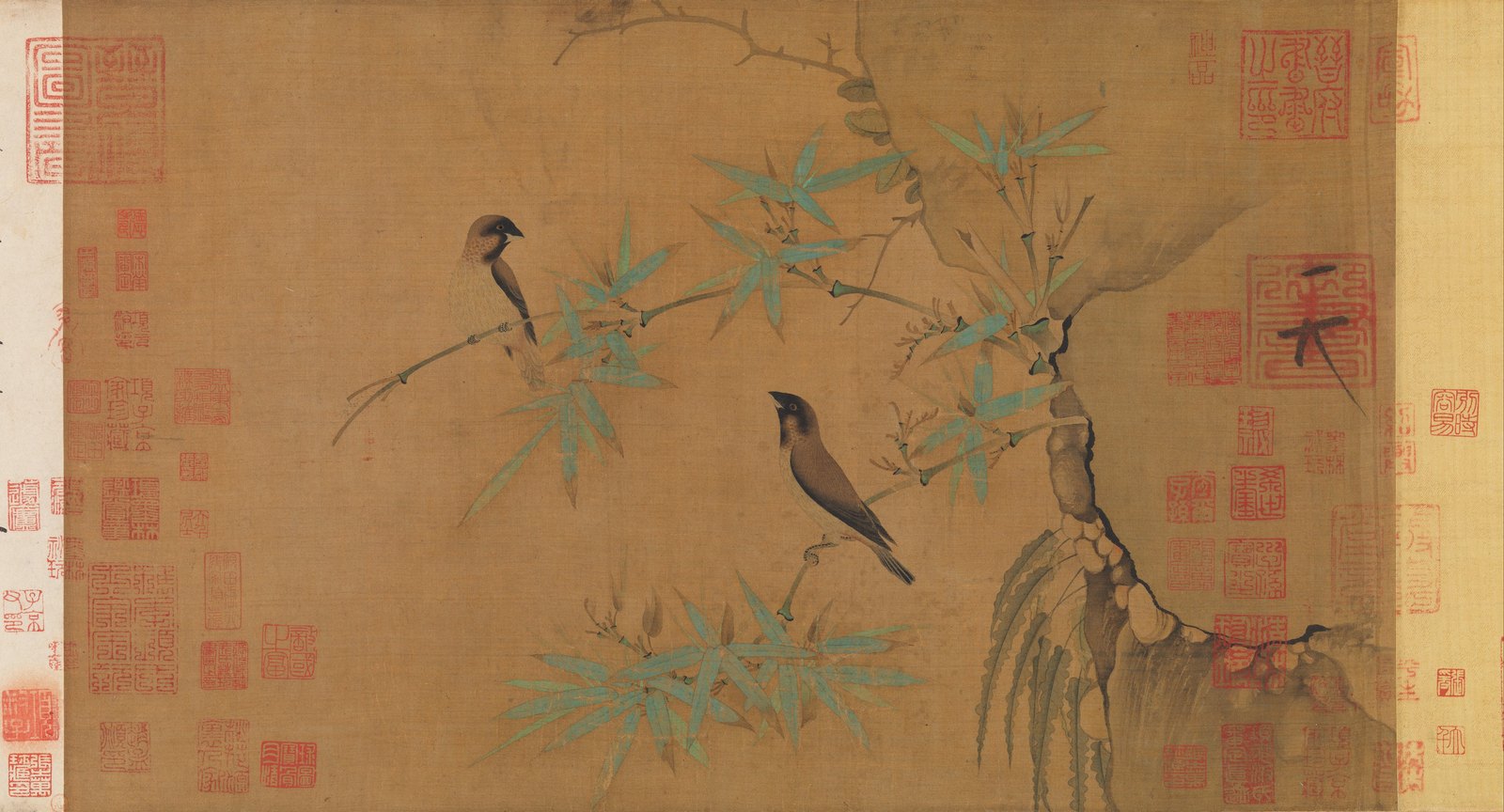
Consider Finches and bamboo, attributed in the Met's catalogue to Emperor Huizong and dated to the early twelfth century. The museum records it as a handscroll painted in ink and color on silk. That material description and format are worth reading before enlarging the image: they identify a specific object, not simply an interchangeable example of bird painting.
Look first at a bird, then at the space needed to see the plant around it. At one scale, the bird can seem to occupy the entire subject; at another, its relation to the branching structure becomes more important. Neither view cancels the other. Moving between them asks you to remember what the screen no longer displays. Your experience of the whole is assembled partly from a succession of partial encounters.
Try describing the image after closing it. Do you remember the bird more clearly than the plant, or a particular direction more clearly than either? There is no exam to pass. The question reveals what your first viewing selected. Open it again and begin with the part you remember least. A second encounter need not simply confirm the first; it can rearrange what you thought the work was about.
Repetition does not have to mean sameness
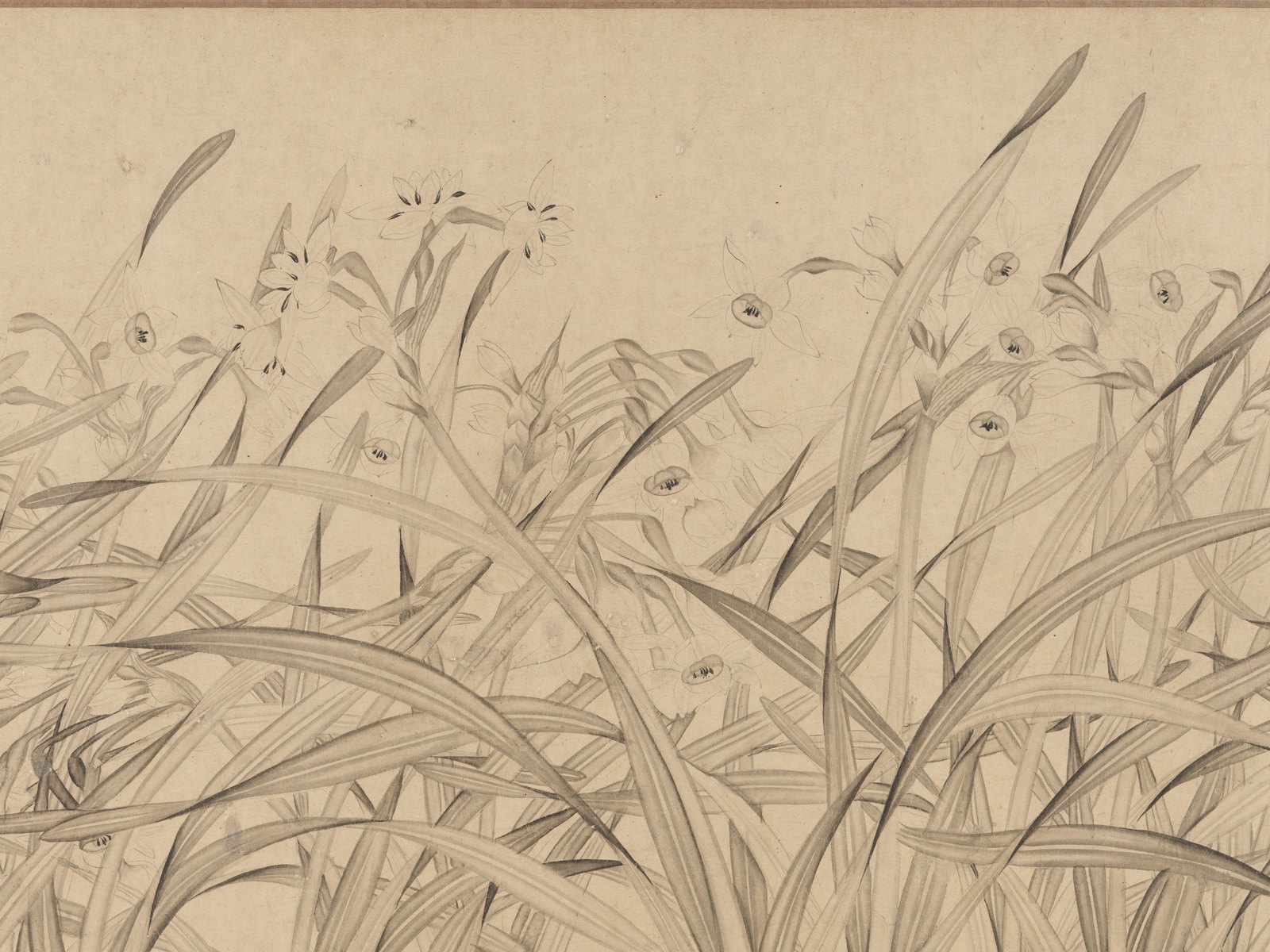
Zhao Mengjian's Narcissus, from the mid-thirteenth century, offers another test. It is an ink-on-paper handscroll. Instead of demanding a single dramatic action, approach the plants as an opportunity to follow recurring forms. Keep your first observations modest: where do lines gather, separate, bend or leave an interval? You can notice those relationships before learning the flowers' literary associations.
A full-length thumbnail may make repetition look like a pattern. At a closer scale, repetition can become a sequence of differences. Choose two neighboring passages and compare how crowded they feel. Then advance far enough that the first is no longer visible. Does your memory exaggerate the contrast? This exercise is not a claim about the artist's intended psychology. It is a way to discover what sequential viewing does to your own attention.
A story is not a filmstrip
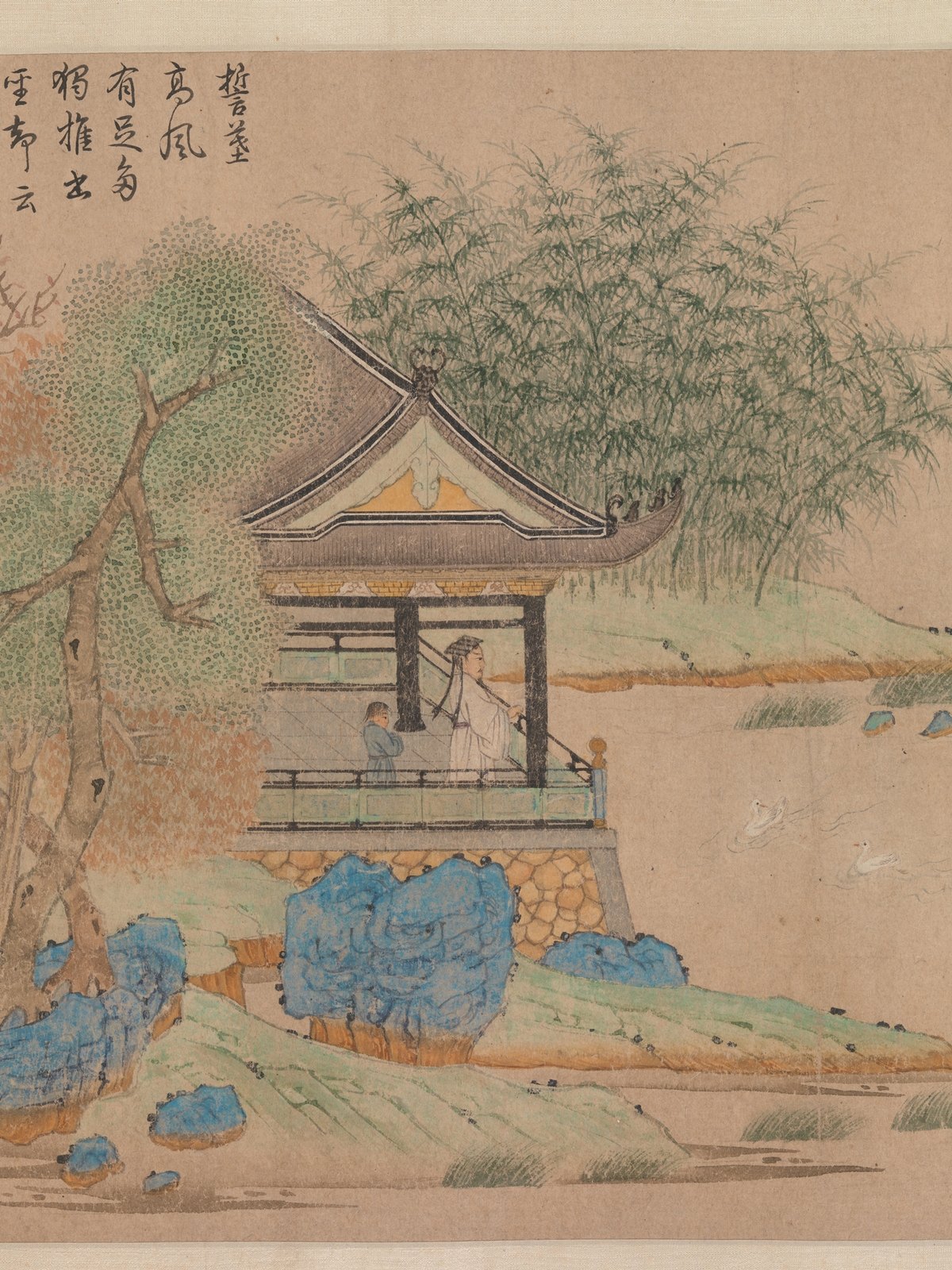
Qian Xuan's Wang Xizhi watching geese, dated around 1295, takes up a story about the celebrated calligrapher and his interest in geese. The Met identifies its medium as ink, color and gold on paper. We should not mistake the work for eyewitness evidence of Wang Xizhi's life: the painting belongs to a much later artist looking back toward an earlier figure.
Its title gives you a reason to search, but do not let that search become a race to find the named person and finish. What visual territory separates one area from another? Where might you pause if the title were hidden? A story can organize a painting without making every section a consecutive frame of action. Resist forcing it into the habits of cinema, where the next frame usually arrives on a schedule you do not control.
A museum view and a digital view both make choices
A reproduction can show you more than a single historical viewing position, and less. It can enlarge details beyond comfortable unaided inspection, yet conceal texture, mounting and scale. A gallery display may offer a stable comparison across a long stretch while limiting proximity. Neither situation is automatically false. Each makes particular kinds of attention easier and others harder.
The useful response is to name the conditions. Are you seeing a whole work or a detail? Does the photograph include the mounting or only the painted area? Is the image so compressed that fine lines disappear? Captions should answer these questions where possible. Cropping a scroll for a screen can be practical, but presenting that crop as the complete composition teaches a misleading lesson about the object.
Let the ending alter the beginning
When you reach the left end, resist treating completion as the sole reward. Return to an earlier section and see whether it now feels different. Something you first passed over may become memorable because of what followed. That is a possibility offered by the sequence, not a hidden message that every viewer must decode in the same way. You are allowed to notice different things on different days.
For more on the marks within a painting, read calligraphy as movement made visible. For the relationship between painted and unpainted areas, explore empty space in Chinese landscape painting. The handscroll adds a practical question to both: not only what is there, but how much can be present to your eyes at one moment? Sometimes a richer view begins by allowing yourself to see less at once.
Join the conversation
What did this make you notice?
Would you rather discover a painting gradually or see its entire composition first—and what might your preference cause you to miss?