
A closer look
The moon in Chinese poetry does not have one fixed meaning. In the two works considered here, it becomes an imagined companion and a witness to separation. Neither role requires us to believe that moonlight abolishes loneliness. What makes these poems moving is almost the opposite: they notice distance precisely, then ask what attention can still accomplish across it.
For Mid-Autumn, this is a more rewarding approach than collecting beautiful quotations. A line printed beside a mooncake can seem like a blessing that has always meant the same thing. Return it to its poem and hesitation, comedy and argument reappear. The moon is not merely an emblem placed at the end of a sentence. It is someone—or something—the speaker keeps addressing.
Li Bai sets another place
Li Bai's first poem in the sequence usually called Drinking Alone under the Moon begins with wine among flowers and nobody close enough to share it. Then the speaker raises his cup, invites the moon and counts his shadow as a third participant. The Chinese original is available in a Hong Kong Education Bureau edition. A deliberately plain rendering of the gesture is: “I lift my cup to invite the bright moon; with my shadow, we make three.”
The arithmetic is funny before it is profound. One person invents a party without pretending that another person has arrived. The moon cannot drink; the shadow follows his body. The poem itself acknowledges those limits. That acknowledgment matters. If we reduce the passage to an inspirational message about never being alone, we remove its intelligence about what imagined company can and cannot provide.
Try reading the invitation aloud, then pausing. Does it sound exuberant, defiant, tender or slightly embarrassed? The words leave room for all four. Instead of deciding which emotion is the correct cultural meaning, listen to how quickly they can alternate. The speaker's inventiveness is inseparable from the situation that requires it. This is company made through language, not loneliness magically cured.
A painting adds an unexpected witness
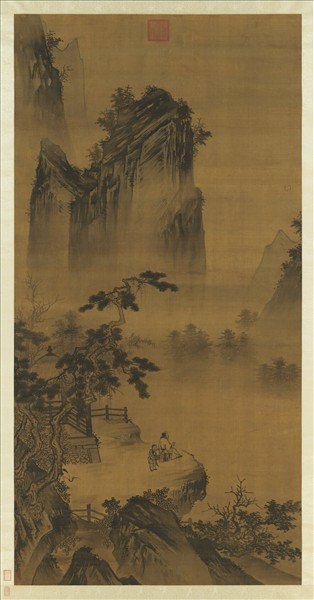
The National Palace Museum's Toasting the Moon in Jest takes up Li Bai's invitation visually. Its old title names Ma Yuan, but the museum identifies the painting with the Ming artist Zhong Li on the evidence of its signature and style. A scholar raises a cup in a mountainous setting; an attendant carries a vessel. The collection record explains both the poetic connection and the revised attribution.
Notice what changes between media. The poem constructs an intimate exchange through a voice. The painting makes that gesture available for another person to observe—and places another person inside the scene. It is therefore not a transparent photograph of the poem, much less a portrait proving what Li Bai did one particular night. It is a later act of interpretation. We are looking at someone looking, across more than one historical distance.
Su Shi argues with fullness
Su Shi's lyric beginning with a question about the bright moon, composed to the tune pattern Shuidiao Getou, moves differently. Its speaker imagines the heavens, returns to human life, notices moonlight reaching someone unable to sleep, and challenges the moon's apparent preference for being round when people are apart. The public-domain Chinese text preserves that changing sequence. This is not one uninterrupted expression of serenity.
The emotional turn comes when human separation is placed beside the moon's changing condition. Fullness is not permanent in the sky either. A new prose rendering of the ending might be: “May we both endure, sharing this moon's beauty across a thousand li.” This is an interpretation of the sense, not an attempt to reproduce the original meter. The distance remains. The wish changes how it can be inhabited.
That distinction feels important when a festival image seems to demand happiness. An empty chair need not be explained away for a celebration to matter. Read the poem as permission to hold affection and incompleteness together, rather than as a command to become content. Its argument does not restore everyone to the same room. It makes a relationship imaginable beyond the room.
Moonlight does not always mean autumn
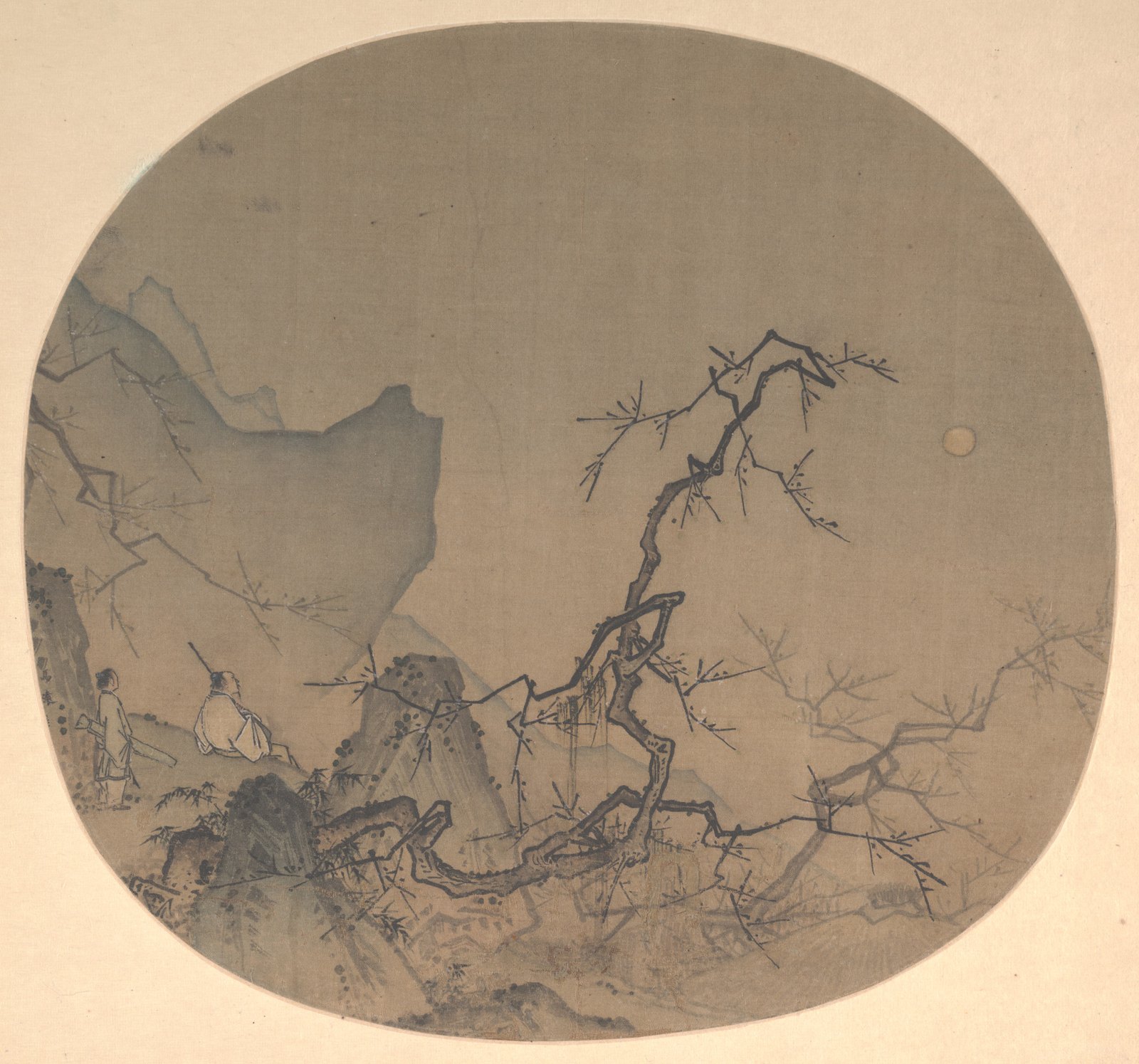
Ma Yuan's early thirteenth-century Viewing plum blossoms by moonlight, in the Metropolitan Museum of Art, offers a useful correction to seasonal assumptions. The museum identifies its setting as an early spring evening. A white-robed figure and the moon occupy different parts of the small composition. It is not a documented illustration of Su Shi's lyric or a record of Mid-Autumn festivities. The Met's object record is explicit about the season.
Placed beside these poems, the painting invites comparison without claiming a common occasion. Ask which you notice first: the person or the light. Then cover that part of the reproduction and look at what remains. Does the landscape feel emptied, or newly spacious? This is an exercise in your own attention, not a reconstruction of a Song viewer's thoughts. Its value lies in making the relation visible before naming it.
What a translation lets you hear
English and Spanish require choices that a short Chinese phrase can leave more open. An elegant English version may emphasize intimacy; a Spanish version may make the wish sound more explicitly addressed to someone. Even deciding whether to preserve li, a measure of distance, or replace it with an approximate everyday expression changes the texture of the ending. No single solution transfers everything.
That is why these short renderings remain deliberately modest. They help us follow the action rather than borrow the authority of a famous translator. When comparing published translations, look not only for the most beautiful phrase but for what each version foregrounds. Does the moon become an object, a companion, a beauty or a shared view? Those differences are an invitation to reread, not a reason to abandon translation.
Keep the distance in the picture
For a quiet Mid-Autumn reading, place the two gestures beside each other: Li Bai offers a cup; Su Shi offers a wish. One makes company in the immediate scene, while the other imagines connection beyond it. Neither requires a perfect reunion. Read a poem, look away from the screen and think of one person who is elsewhere. The exercise has no prescribed feeling and needs no photograph to prove it happened.
Our Mid-Autumn introduction explores the wider festival. To continue looking, visit the spaces in landscape painting and calligraphy as movement. Here, the smaller question is enough: how can a visible thing help us address somebody we cannot see?
Join the conversation
What did this make you notice?
Does the moon in these poems feel more like a companion, a reminder of absence or a view you could share with someone far away?