
A closer look
The famous faces at Longmen make powerful photographs, but a photograph of a face cannot explain the whole place. South of Luoyang in Henan, the grottoes occupy limestone cliffs beside the Yi River. Their major phases of carving span the Northern Wei and Tang periods. UNESCO's site account describes a large, layered ensemble rather than a single monument produced at one moment.
That distinction suggests a better opening question than “Which statue should I photograph?” Ask how a person moves through the site, and how a sculpture directs that movement. Then ask what has disappeared. Some works survive in the cliff; others survive elsewhere as fragments or reconstructed museum objects. To understand Longmen is to keep those different conditions in view without making any one of them stand for the whole.
Start outside the frame
Imagine cropping a building until only one window remains. You might learn a great deal about its carving while losing the way it belongs to a street. A tightly framed Buddha can produce a similar trade-off. Detail is not the problem. The problem begins when the detail becomes the only available explanation of where we are and how the place works.
Begin with a wider view before moving close. Locate rock, openings and the space in front of the figures. Notice what the photograph includes at ground level and what it leaves outside its borders. You do not need to identify every figure to see that the setting changes the encounter. A sculpture approached within a carved space is not experienced exactly like an isolated object against a neutral museum wall.
The cave is not just a container
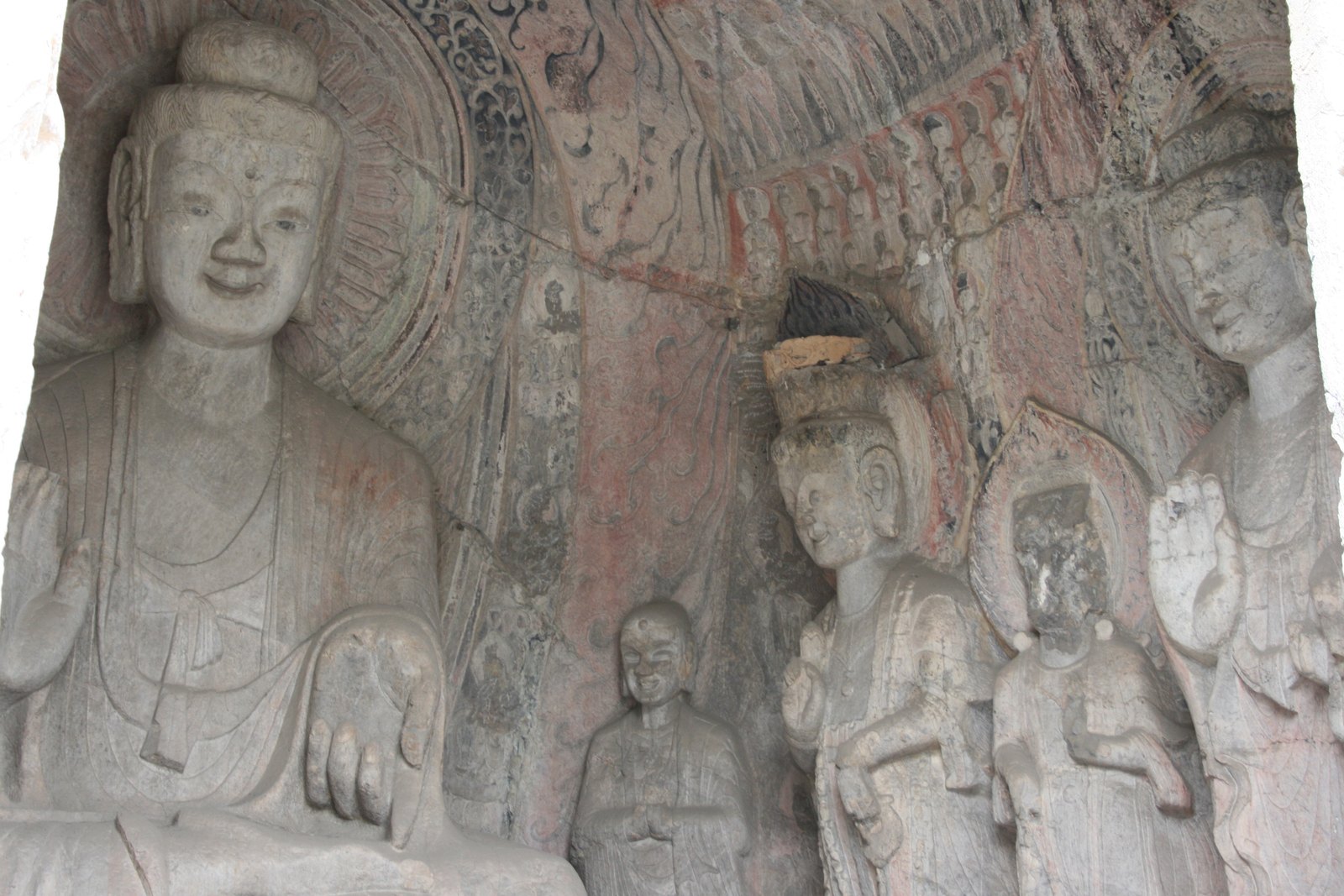
Think of a cave as an arrangement of attention rather than a box holding statues. Where do figures face? Which surfaces can a person see upon entering, and which become visible only after turning around? These questions are especially useful for the Central Binyang Cave. They shift the focus from a list of masterpieces to relationships among images, bodies and architecture.
The University of Chicago's Dispersed Chinese Art Digitization project explains that elaborate reliefs once occupied the wall around the cave's doorway. Early twentieth-century looting broke and removed much of that work. Some pieces reached museums; others were lost. The project uses surviving evidence to investigate the damaged ensemble. The empty or altered surface is therefore part of the story, not merely a disappointing interruption of it.
A procession that once turned a corner
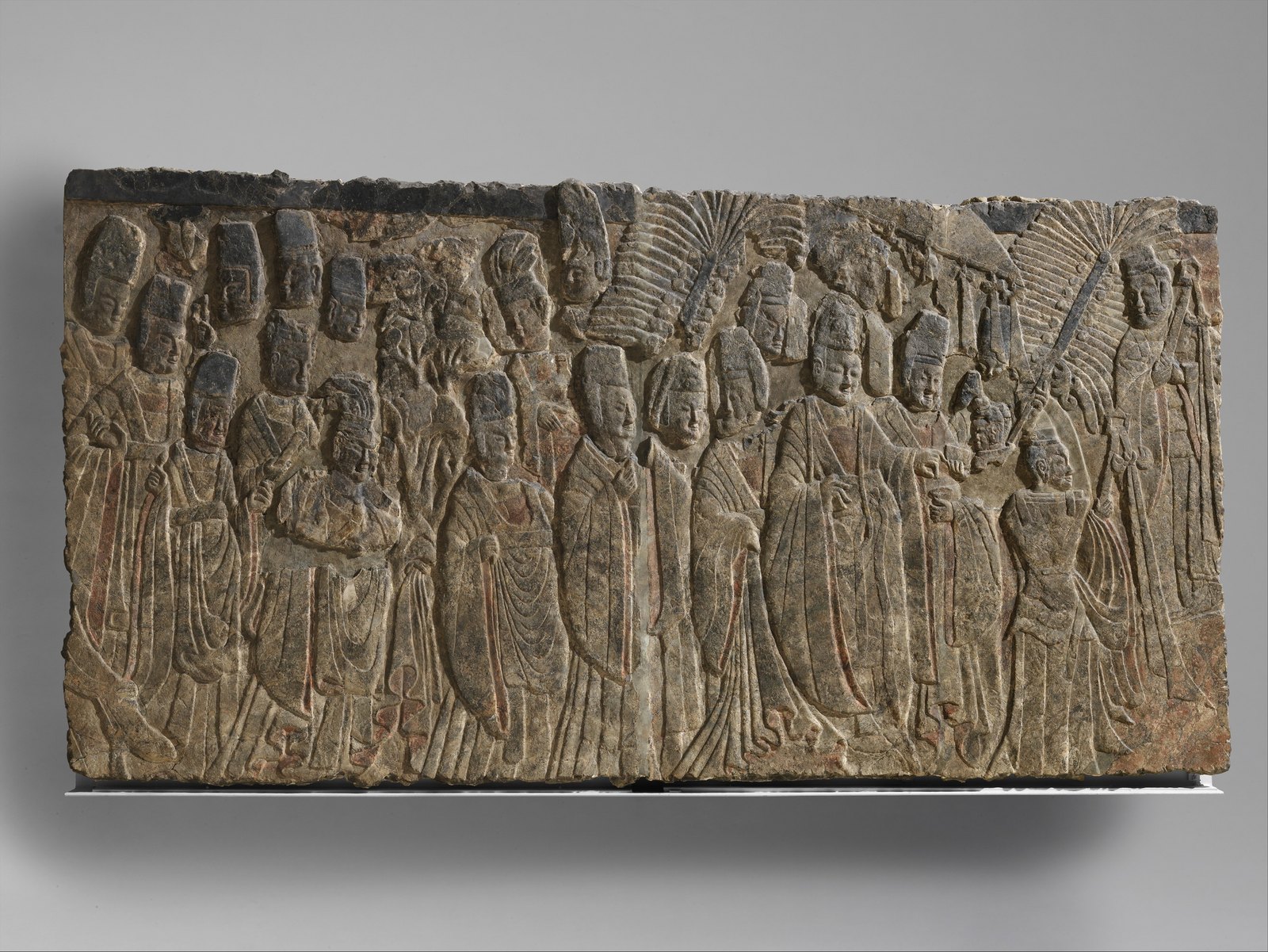
One surviving work is now in New York: the Met's limestone relief Emperor Xiaowen and his entourage worshipping the Buddha, dated around 522–23. It came from Central Binyang. The museum explains that trees within the composition marked a turn from one cave wall to another. Its imperial participants are understood in relation to the cave's patronage and commemorative purpose, rather than as an unambiguous contemporary portrait session.
That corner is a small fact with a large consequence. A photograph presents the relief as a broad rectangle. Its original arrangement involved a change of direction. The object we see has not only traveled geographically; it has changed its relation to a viewer's body. Before treating the museum image as complete, try imagining what it meant to encounter a procession across adjoining surfaces rather than all at once.
Now look at the group rather than searching only for the emperor. Follow the spacing of heads and the repeated lines of clothing. Where does your eye move quickly, and where does it stop? These are questions you can test directly against the reproduction. They do not require us to invent the private thoughts of the represented figures. The work's rhythm is available even where its full original context is not.
Grandeur and intimacy are different questions
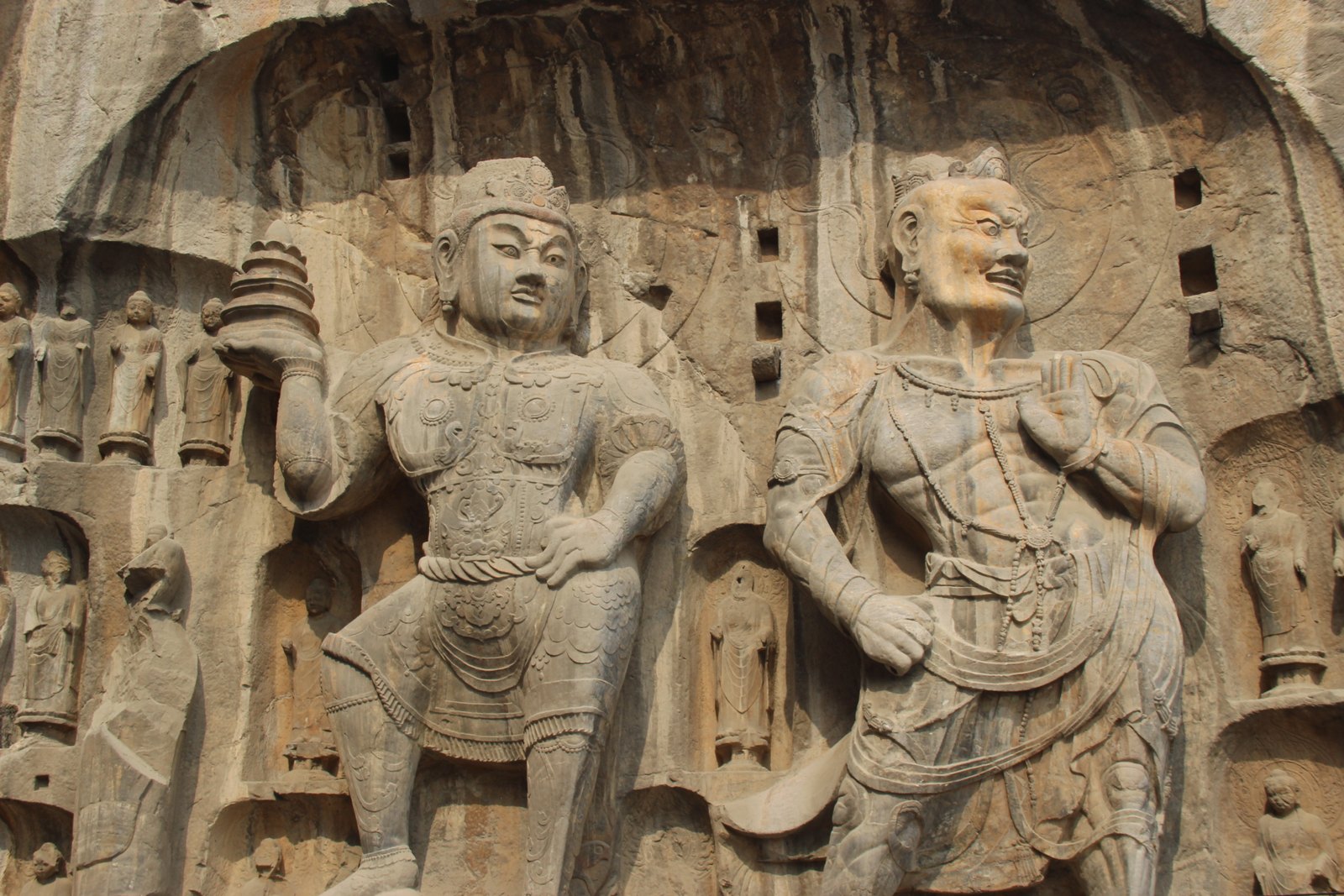
The monumental Fengxian ensemble, associated with Longmen's Tang phase, and Central Binyang do not have to compete for your attention. Their differences can help you ask better questions about scale. What happens when a face is much larger than a body standing before it? What changes when several figures share an enclosed or bounded setting? The UNESCO account provides the historical framework; looking supplies a more personal investigation of encounter.
Avoid turning those observations into a simple ranking of dynasties or styles. Large does not automatically mean more important, and an intimate view does not guarantee a more authentic spiritual experience. A camera can make a small figure monumental or flatten a vast setting into a neat graphic. Comparing the two photographs is useful partly because it reminds us that we are comparing ways of showing as well as things shown.
Do not make damage picturesque
A missing head or broken edge can look compelling in a photograph. But describing damage only as the beauty of age turns a historical question into an atmosphere. Weathering, intentional removal and later repair are not interchangeable explanations. Where the evidence is not supplied, say that the cause is unknown rather than assigning every scar to one dramatic episode.
The same caution applies to digital reconstruction. A reconstruction can help us ask where a fragment belonged; it does not make the original loss unhappen. Look for the distinction between surviving material and an inferred connection. A persuasive image is not automatically conclusive evidence. The most useful reconstruction is one that lets a reader understand both what can be recovered and where uncertainty remains.
Visit with two kinds of attention
Whether you encounter Longmen in person or through collections online, alternate close looking with contextual questions. Spend time with one face or one fold, then step back to ask where the work belongs. Keep the cave name with the image you save. If a work is in a museum, record its present location as well as its original one. A caption can preserve a relationship that a beautiful crop would otherwise erase.
This approach also changes how we discuss cultural travel. A place need not be reduced to a checklist or a claim of personal transformation. Understanding one connection accurately can be more valuable than collecting many spectacular images. For another cave-art encounter, read Dunhuang as a library of color; for the power of an intentionally arranged environment, explore a Suzhou garden's borrowed world. Longmen offers its own question: what must we remember when an object survives but the relationship around it has been broken?
Join the conversation
What did this make you notice?
When you see a sculpture in a museum, what would help you imagine its original setting without pretending that nothing has been lost?