
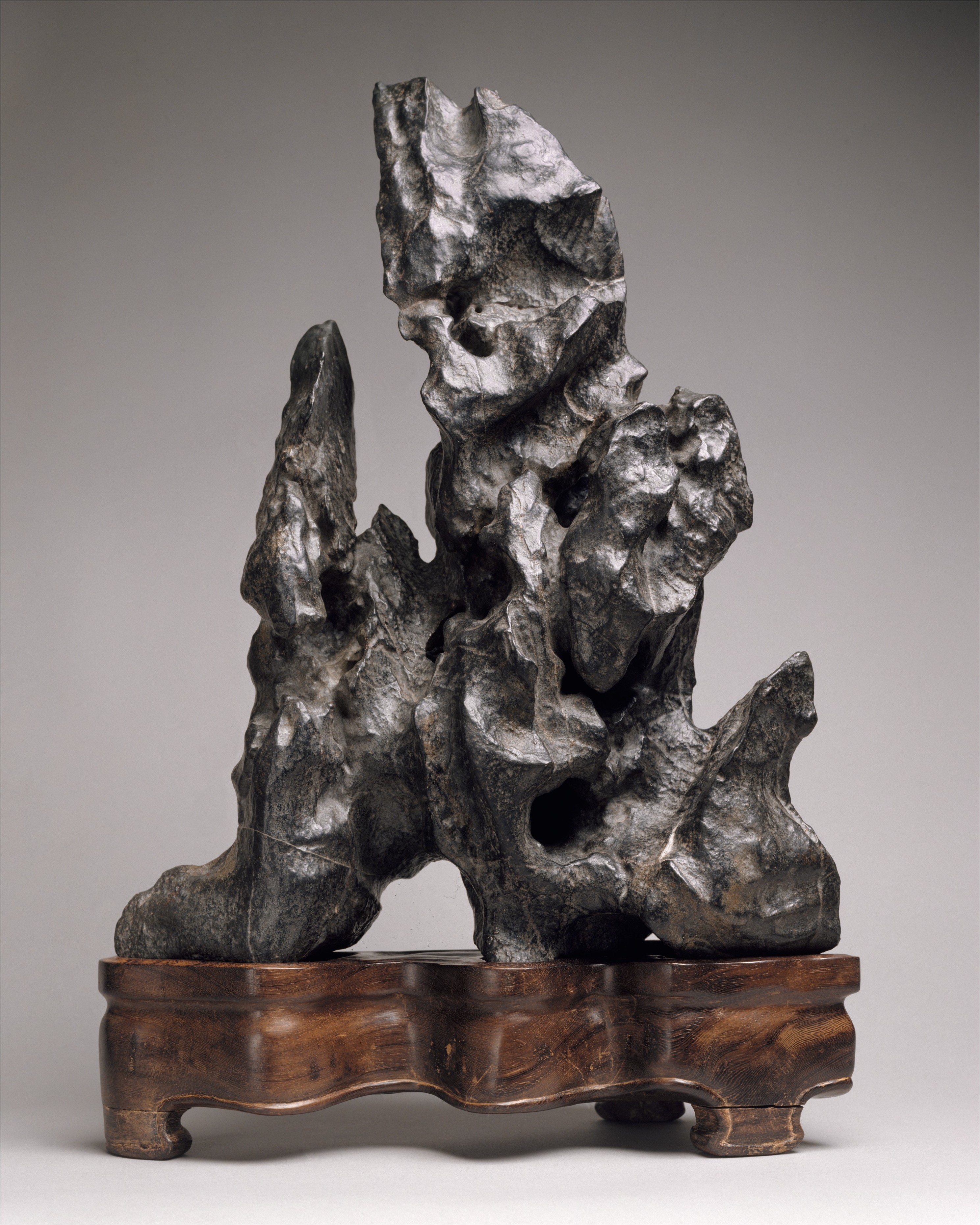
A mountain that fits inside a room
Large rocks have long organized Chinese gardens. They interrupt paths, frame water and compress the scale of mountains into cultivated space. By the early Song dynasty, smaller ornamental stones had also entered scholars’ studios. A collector could turn a stone in the hand or study it beside books, ink and painting. The object brought geological duration into a room devoted to human thought.
The reduction in size was not a reduction in imaginative scale. A cavity might become a grotto; a narrow ridge, a remote path; a top-heavy profile, a peak rising through cloud. This does not mean that every hole carried a fixed symbol. The pleasure lay in the movement between material fact and mental landscape. Stone remained stone while offering more than one possible world.
Four qualities teach the eye
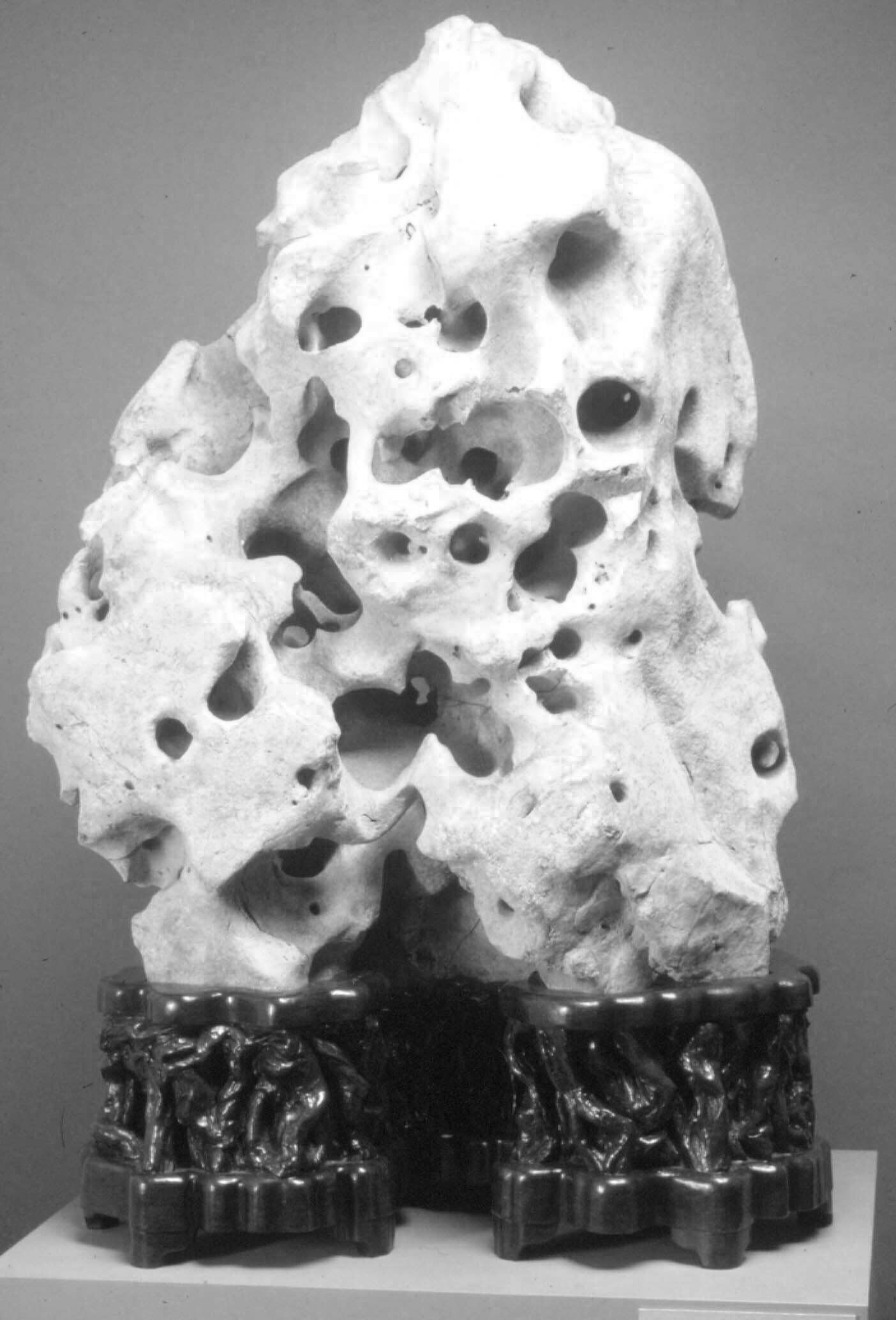
Historical writing identified qualities often translated as thinness, openness, perforation and wrinkling. They encouraged admiration for vertically oriented forms, unexpected voids and richly worked surfaces. These words are not a scoring system that can certify beauty. They are prompts for attention.
Begin with the silhouette. Is the mass balanced or apparently impossible? Then let your gaze pass through the holes instead of stopping at the surface. Follow furrows and changes in texture. Move around the object: a convincing rock rarely has only one front. Light will close some cavities and reveal others, so the sculpture changes without moving.
Nature and intervention meet
Collectors especially valued stones shaped by natural processes or made to appear so. Yet the boundary between discovery and making can be difficult to draw. A stone might be cut at the base, cleaned, drilled, weathered further or subtly adjusted. Its stand was purpose-built, lifting and orienting it for a particular reading.
Rather than asking whether human intervention makes a rock “fake,” ask what kind of collaboration is visible. Geological forces produce density and erosion; selection turns one stone into an object of attention; mounting establishes scale and posture. The collector does not claim to have created the mountain. The display creates conditions in which its form can be encountered.
The pedestal is part of the argument
A carved wooden base is not merely furniture. It can echo the contour of the stone, stabilize a precarious mass and separate the object from an ordinary piece of ground. Its polished warmth contrasts with mineral coolness. Together, rock and stand make a compound work in which irregular nature meets deliberate craft.
Museum photographs sometimes crop the base or flatten its relation to the stone. Look for side views and dimensions. A rock that appears monumental online may be smaller than a table lamp; another may be large enough to organize a courtyard. Scale changes the body’s relationship to it, and therefore changes the kind of wandering the imagination performs.
Rocks move between garden and painting
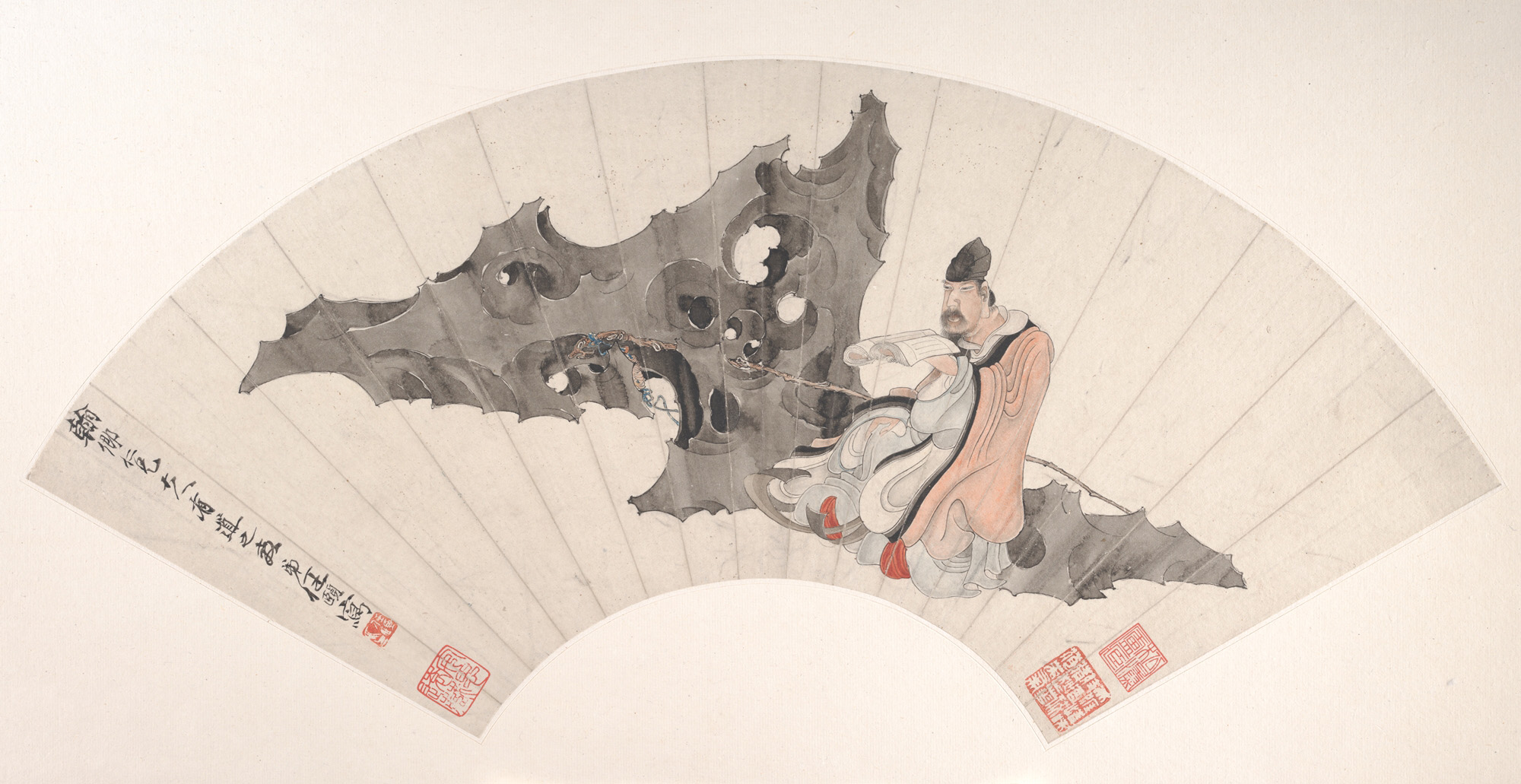
Painted landscapes helped viewers recognize mountains in stones, while fantastic rocks gave painters forms that exceeded ordinary topography. A scholar seated near an eroded rock could appear in harmony with it: folds of cloth answer scalloped edges; ink texture answers mineral texture. The exchange worked in both directions.
This is why a scholar’s rock belongs to more than the history of collecting. It touches garden design, poetry, calligraphy, furniture and the ethics of cultivated attention. A stone asks for slowness without promising spiritual transformation. It makes concentration possible; what the viewer does with that concentration remains open.
How to look without inventing a legend
Give the object time before naming what it resembles. Describe its weight, direction, holes and texture. Then allow associations to arrive. If you see a dragon or cliff, treat that as your encounter, not necessarily the maker’s intention. Check the stone type, date, provenance and stand when the record provides them.
Terms such as Lingbi and Taihu refer to admired stone traditions and sources, but labels can be uncertain, especially in the market. A dramatic profile alone does not prove age or origin. Responsible collecting requires evidence about extraction, ownership and any alteration. Cultural admiration should not excuse damage to protected landscapes or vague provenance.
An object that refuses a final image
Most designed objects tell the eye where to settle. A scholar’s rock keeps redirecting it. Solid and void compete; the front becomes a side; an ugly protrusion becomes the feature that holds the whole form together. Its luxury is not polish or preciousness alone, but inexhaustibility.
To look well is to keep the stone materially present while letting it exceed itself. That tension—between a limestone object and a mountain imagined at another scale—is the heart of the experience.
Join the conversation
What did this make you notice?
What natural object have you kept because it seemed to contain a landscape or story larger than itself?