
What made a vessel ritual?
Chinese ritual bronzes were vessels used in ceremonies, including offerings to ancestors during the Shang and Zhou periods. Their significance was not exhausted by containing food or drink: use and setting mattered. A wine vessel in a museum is therefore more than an unusually elaborate ancestor of a modern glass.
That distinction becomes easier to explore through three objects than through a roomful of unfamiliar names. The photographs here show a tall beaker, a lidded container and a smaller open cup from the Metropolitan Museum of Art. Put their outlines beside one another in your mind. One opens dramatically upward; another gathers its volume beneath a lid; the third offers a much quieter curve. Before assigning a story to the ornament, notice how differently each object organizes the space it could contain.
These are not instructions for recreating an ancient ceremony. They are a way into the surviving evidence. The distinction matters because a photograph makes an object available to us while leaving its original occasion largely outside the frame. We can learn from that distance without pretending to erase it.
The gu: an opening that changes everything
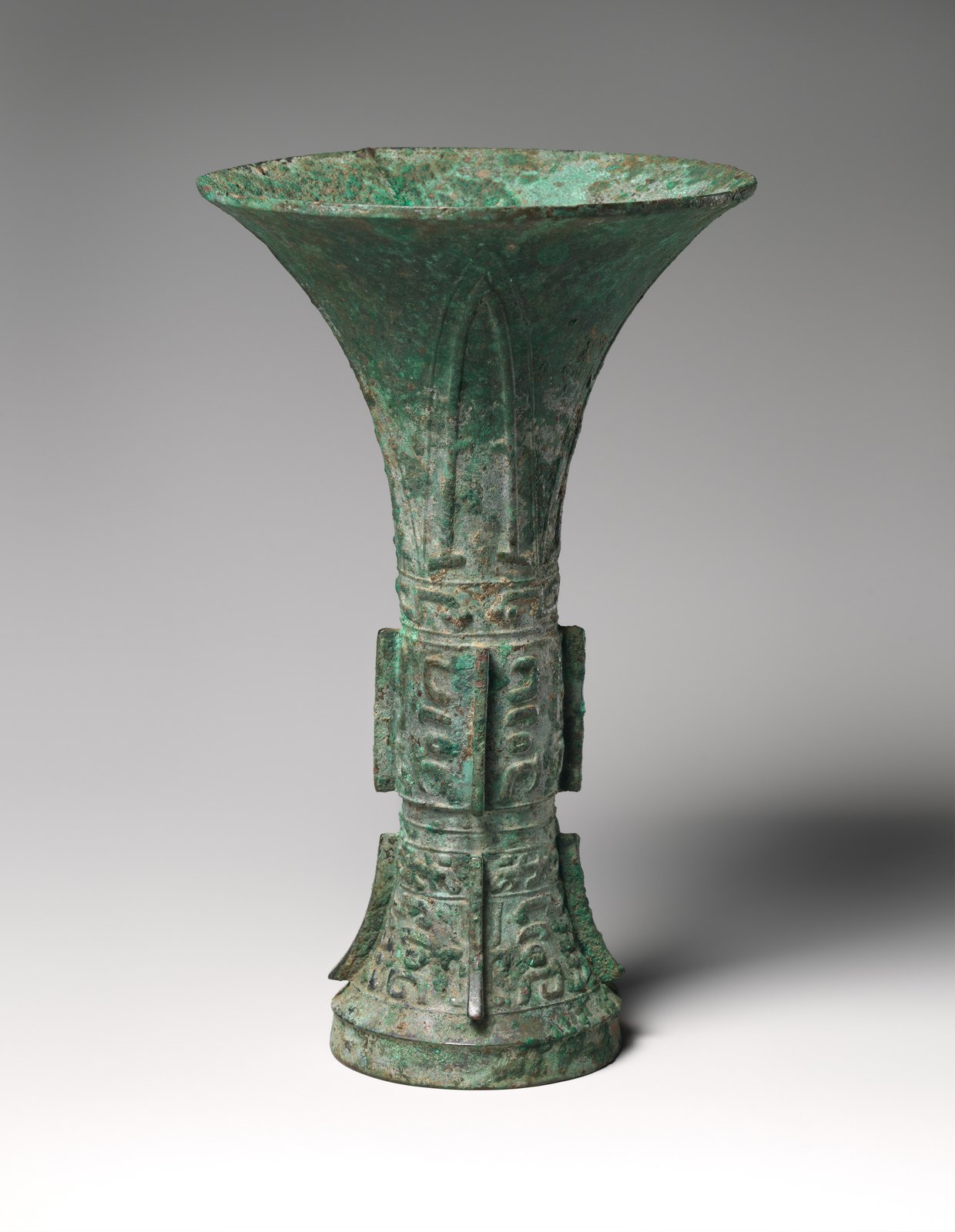
The museum dates this gu beaker to the late eleventh century BCE. Its mouth spreads much farther outward than its narrow middle. Follow the silhouette from the foot upward: a small outward curve gives way to a constriction, then to the broad flare. Even before examining the decoration, you can see a sequence of expansion, compression and release. The hollow mouth is part of the design, not simply the place where the metal stops.
Now look lower down. Vertical ridges interrupt bands of relief, while longer pointed forms climb toward the opening. The eye can travel in two directions: around the decorated body or upward along its profile. Try temporarily covering the flared upper portion on your screen. The remaining object feels denser and more compact. Uncover it, and the wide rim changes the balance of everything beneath. This is a visual observation, not a claim that we know the maker's intended symbolism.
The uneven green and brown surface adds another layer to the encounter. Do not mistake its present texture for a complete record of the original finish; burial and age change bronze surfaces. What we are viewing is both a designed form and an object that has endured.
A lid makes an interior present
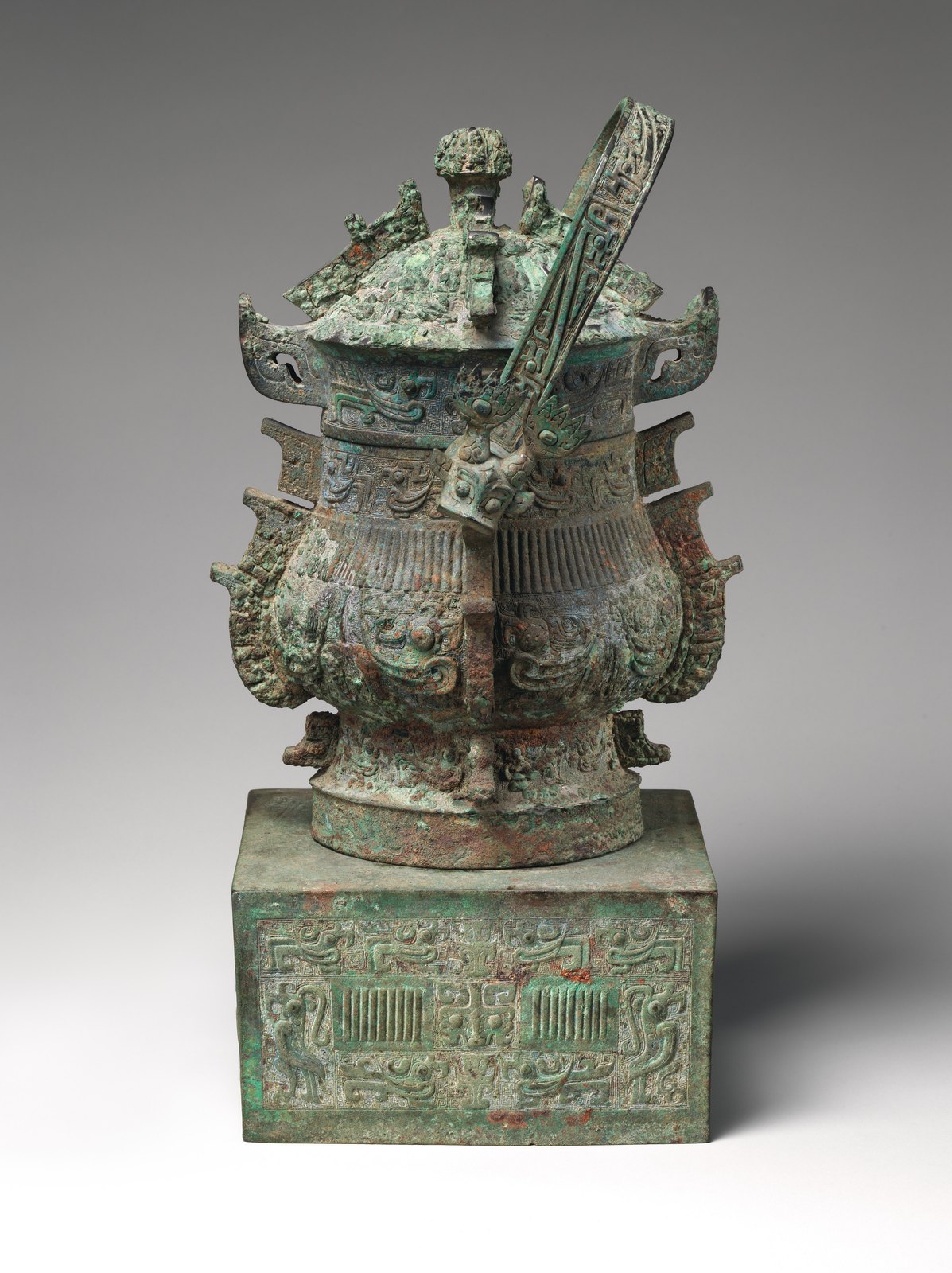
The covered wine container presents a different problem. In this photograph, a handle rises beside a decorated lid, and projections break the outline of the rounded body. The lid conceals what the open beaker exposes. We recognize an interior without being able to see it, and that simple difference changes our encounter with the object.
Look first at the join between lid and body, then at the handle. Imagine the separate actions these features make possible: uncovering, closing, lifting. This is not evidence that a particular person performed those actions in a particular order. It is a way to recover the practical questions embedded in a form. A container is not only a sculptural surface; it negotiates access to something held inside. The ornament must coexist with that practical architecture.
The rectangular support in the photograph establishes another contrast. Its straight edges make the swelling body above appear more pronounced. Rather than reading every protrusion as a separate symbol, trace how shadows gather beneath the projections and retreat across flatter areas. The photograph cannot supply the object's weight or the feel of its handle, but it does show how deeply the surface interrupts the light.
A small cup puts scale back into the picture
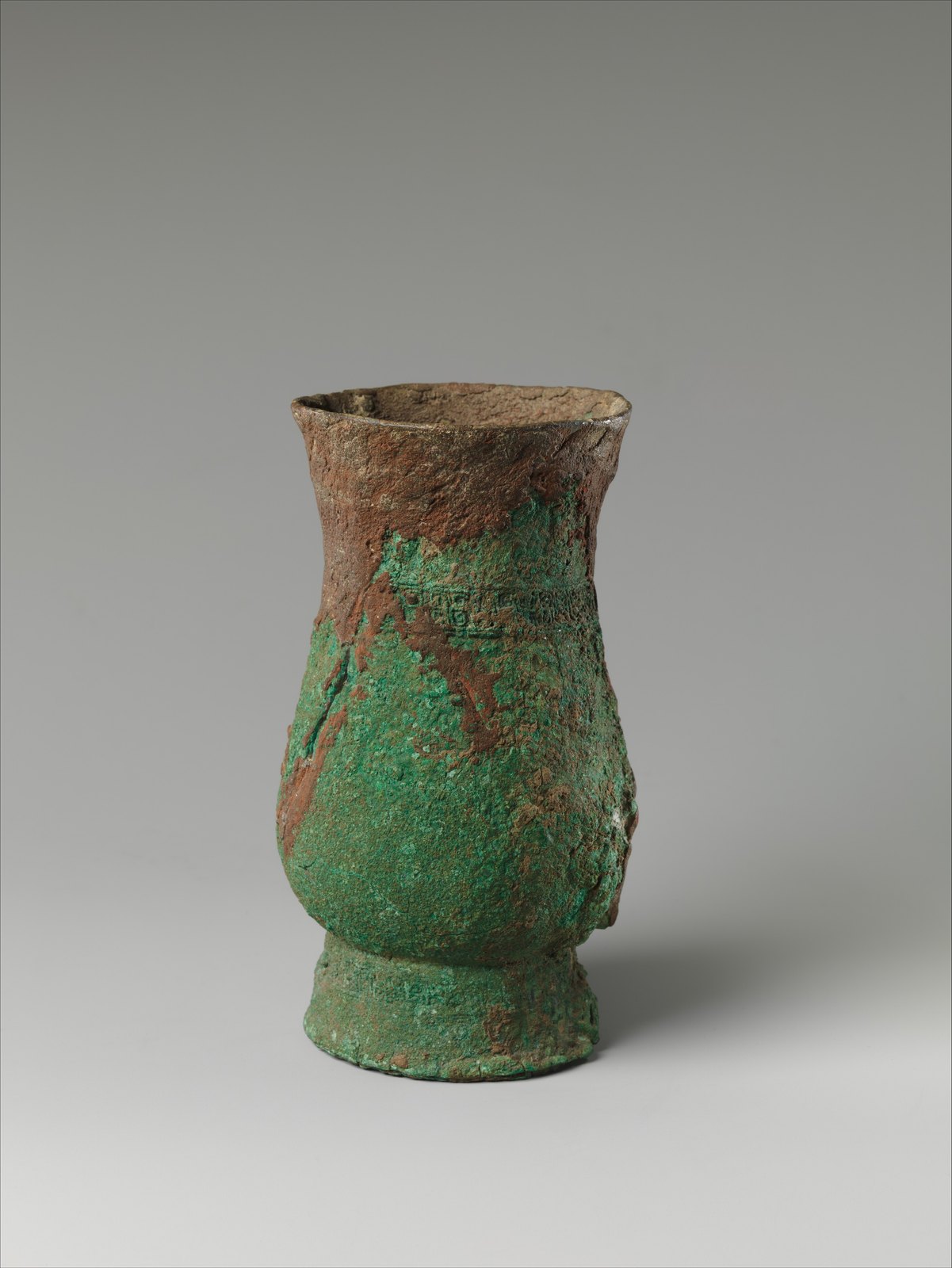
The zhi cup is only 12.7 centimetres high. It has a swelling lower body, a narrower neck and an opening that widens gently. Beside the container's restless outline, its silhouette seems restrained. Yet a smaller, quieter object is not automatically less worthy of attention. Its proportions ask for a closer kind of looking, especially where the neck turns toward the rim.
On a phone, museum photographs can make these vessels seem almost the same size. Each fills a similar rectangle, and the eye obligingly enlarges the cup to meet the beaker. Measurements interrupt that illusion. They do not tell us exactly how an object was handled, but they stop the screen from replacing physical scale with photographic prominence. An elegant photograph is an invitation to inspect, not a substitute for every property of the thing photographed.
The word wine also needs care. The National Gallery of Art's archaeological teaching guide discusses millet-based drink in this context; the label should not automatically suggest modern grape wine. Nor does it reveal the exact contents of this particular cup. A familiar English word can help us begin and still require adjustment.
The arrangement is a question, not a recovered performance
The Met reconstructs the wider group cautiously. Corrosion marks suggest positions for three principal vessels, but the remaining arrangement is hypothetical. Differences in inscriptions and style also leave the original grouping uncertain. A coherent museum display should therefore not be read as a complete record of one ceremony.
This uncertainty is useful, not disappointing. It teaches us to separate three things that an attractive display can make seem identical: objects surviving together, objects placed together today, and objects used together in the past. A photograph may establish the second immediately while the other two need additional evidence. Asking which relationship has actually been demonstrated makes the objects more interesting, because it restores the work of interpretation to view.
It also changes the story we might tell. We should resist furnishing the missing room with invented music, gestures, clothing or dialogue. The temptation is understandable: a complete scene is easy to picture. But a persuasive scene is not necessarily a supported one. Here the productive exercise is smaller. Compare the three forms, then ask what kind of evidence would be needed to connect them to a shared action.
Let the vessel change the question
Return to the open mouth of the gu, the covered interior of the container and the modest scale of the zhi. The point is not to rank them by intricacy. Each offers a different relationship between inside and outside, access and enclosure, surface and volume. Seeing those relationships gives the word ritual a material starting point without pretending that shape alone explains a belief.
Our guide to Chinese incense burners offers another encounter with an object whose function cannot be separated from its setting. For a different way to examine an elaborate surface, continue with Chinese carved lacquer. These are comparisons in looking, not claims that objects separated by centuries share one ceremony or one meaning.
The reward is a more precise curiosity. Instead of asking only what an ancient object symbolizes, we can ask what its opening permits, what its lid withholds, how its scale affects our impression and where our knowledge stops. The bronzes remain beautiful, but their beauty becomes less detached from evidence. We do not have to complete the lost ceremony to leave with a richer understanding of the vessels.
Join the conversation
What did this make you notice?
Which changes your impression most: a vessel's open mouth, its lid, its scale—or learning that the arrangement is uncertain?