
A closer look
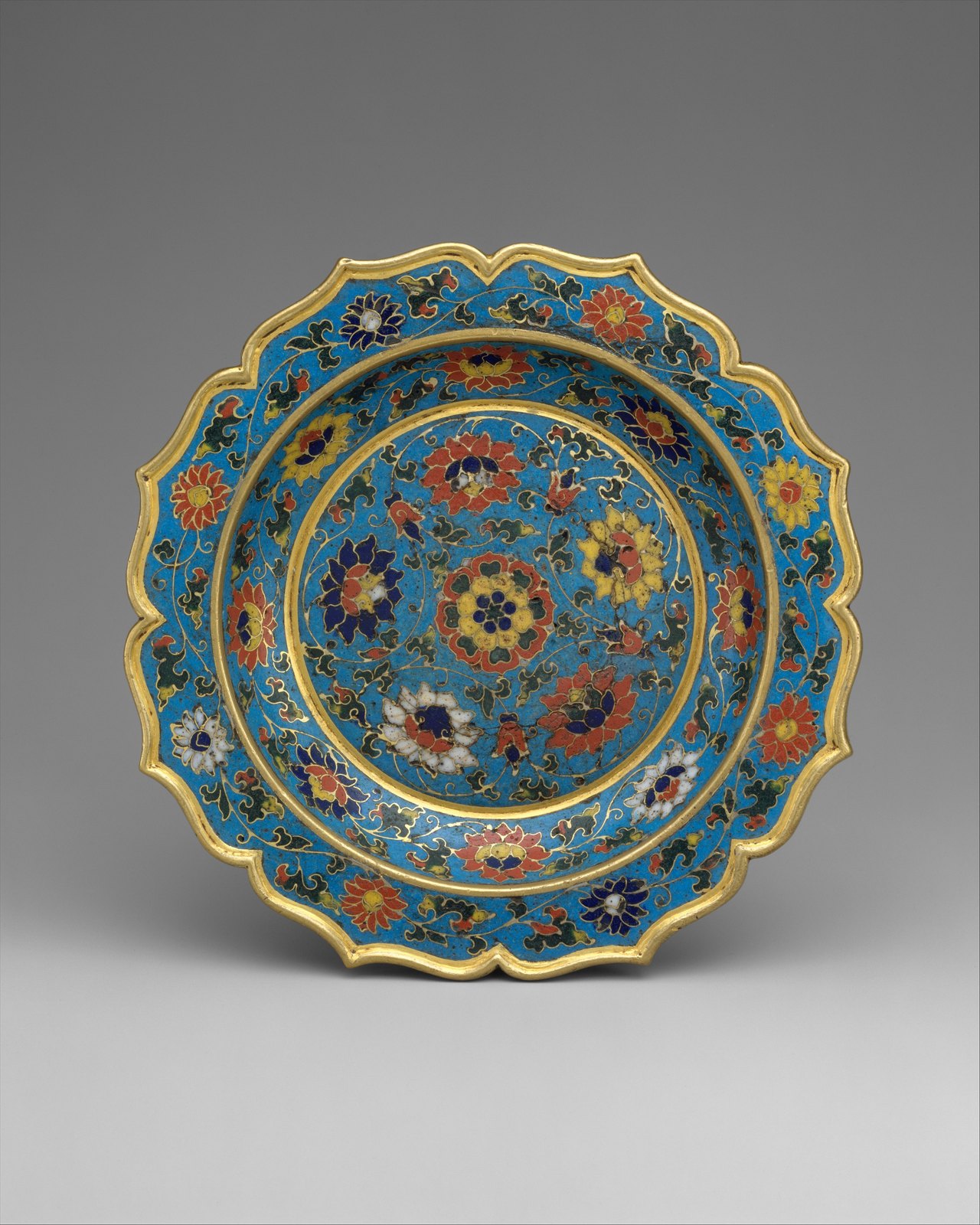
A bright blue Chinese dish can initially seem to belong to the same family as painted porcelain. Then the light catches a narrow metallic boundary around a flower. Similar boundaries divide the leaves and turn the background into small enclosed spaces. The surface begins to read differently: colour is not only spread across a support, but organized into compartments. This is the useful first clue to cloisonné. Before looking for a dynasty, a symbolic meaning or a price, look at the relationship between the line and the colour it contains.
That relationship makes this technique especially rewarding on a screen, provided the image is sharp enough to enlarge. From a distance, a dish offers a strong silhouette and a field of ornament. Closer in, it becomes a network. Neither view replaces the other. The larger composition depends on small decisions about where one enclosure ends and the next begins. Moving between those two scales is a more revealing introduction than treating every richly decorated Chinese object as an example of the same elaborate style.
The boundary is part of the making
In the Metropolitan Museum's account of the technique, metal wires form compartments on a metal body; coloured enamel fills them. Firing and refilling build the surface, which is subsequently rubbed down to expose the compartment edges. This is not paint on porcelain. The distinction is structural, even when the finished colours look similarly brilliant.
Think of a line in a drawing and a line that is also a small physical boundary. They may describe the same curve, but they ask different things of the maker. In the latter, a leaf must become a space that can contain material. A curl must belong to a network that continues around a three-dimensional form. Looking this way makes the metalwork visible again. What seemed like a picture wrapped around an object is also an arrangement of tiny adjacent fields.
There is no need to pretend that a photograph teaches the complete workshop process. It cannot tell you how a particular wire was attached, how many firings an individual object received, or which repairs may have been made later. Those questions require technical evidence. What it can do is help distinguish the visible design from the method that supports it. Recognizing that limit is part of learning to look, rather than a failure to understand the object.
A dish makes the pattern turn
An early fifteenth-century foliated dish gives us a compact place to begin. The museum identifies its decoration as stylized lotus scrolls. Against the turquoise field, flowers and stems form a circular composition; the scalloped edge gives the perimeter its own rhythm. This is a specific early Ming object, not a colour chart for all Chinese enamel.
Try covering the centre of the image with your hand. The rim still carries a clear sequence around the dish. Now cover the rim instead. The middle has a different density and organization. When the whole photograph is visible again, the object feels less like an undifferentiated mass of ornament. It has zones. A successful dense design need not make everything equally important; repetition can guide attention as effectively as a large empty space can.
The flowers are also worth seeing as shapes before turning them into symbols. Notice the alternation of rounded blossoms and slender stems, and the way warm colours punctuate a cooler ground. You do not need a secret dictionary to see these relationships. An interpretation of a particular flower's significance may enrich the encounter, but it should not prevent the simpler and equally valuable experience of noticing what the composition actually does.
A box asks you to imagine another view
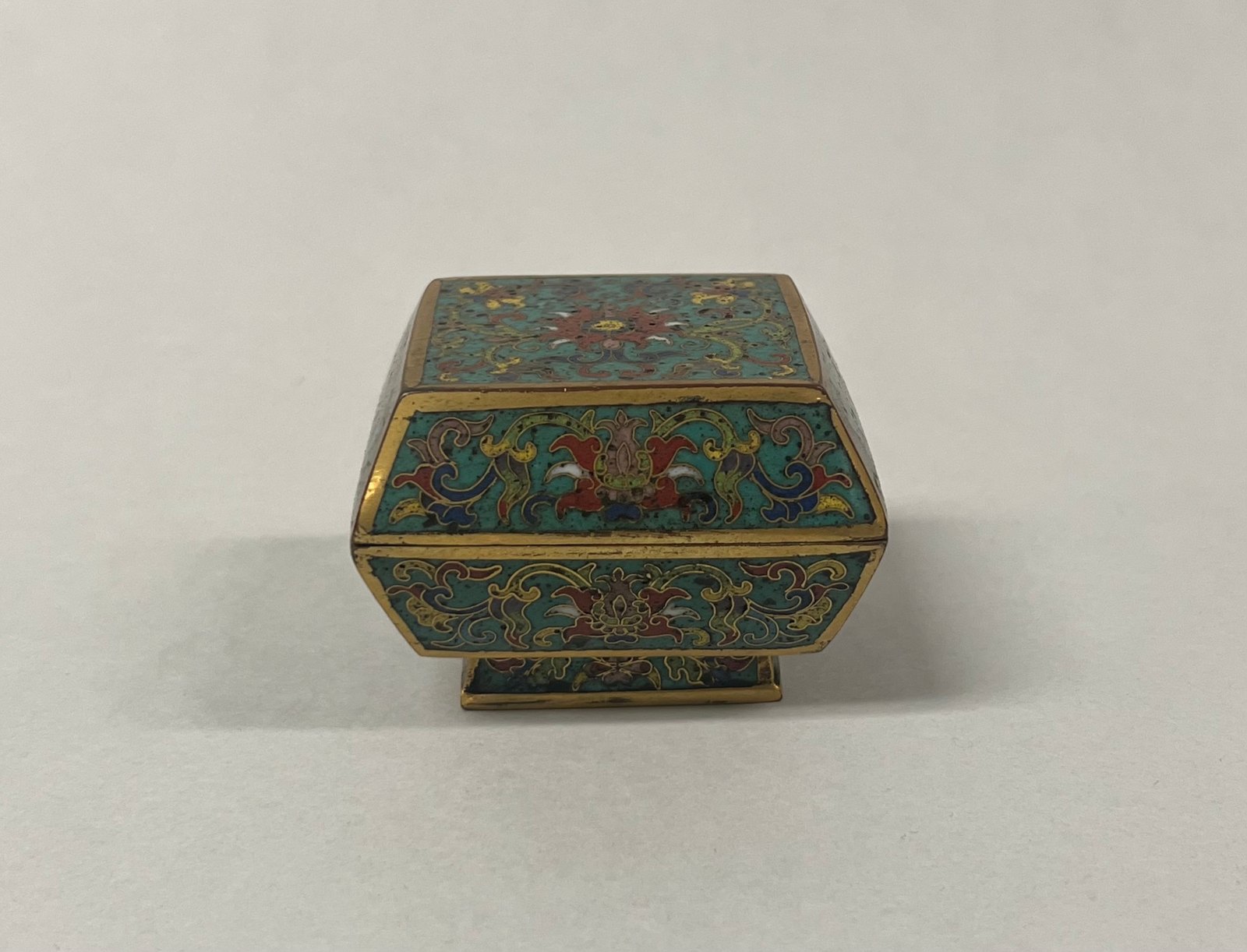
The covered box dated to the late seventeenth or early eighteenth century changes the problem. Its photograph shows a lid, sides and a foot, rather than one continuous dish interior. The transition between surfaces matters. A border can make the lid legible as a separate part even while the decoration connects it to the body beneath.
Follow the corners with your eyes. On a flat reproduction, a floral pattern can seem infinitely repeatable; on a box, it has to negotiate edges. The design must work with a form that closes, opens and occupies space. This is one reason to retain an overall photograph alongside details. Enlarging one flower may reveal the enamel, but it removes the practical architecture that makes the flower part of this particular object.
We should not invent the box's original contents from its attractive appearance. Nor does a museum title tell us who handled it on a particular day. The absence of such a story leaves room for another kind of attention: how the object manages its surfaces, how a lid changes our expectation, and how the same material technique behaves when it is no longer organized around a circle.
What a monochrome photograph can—and cannot—show
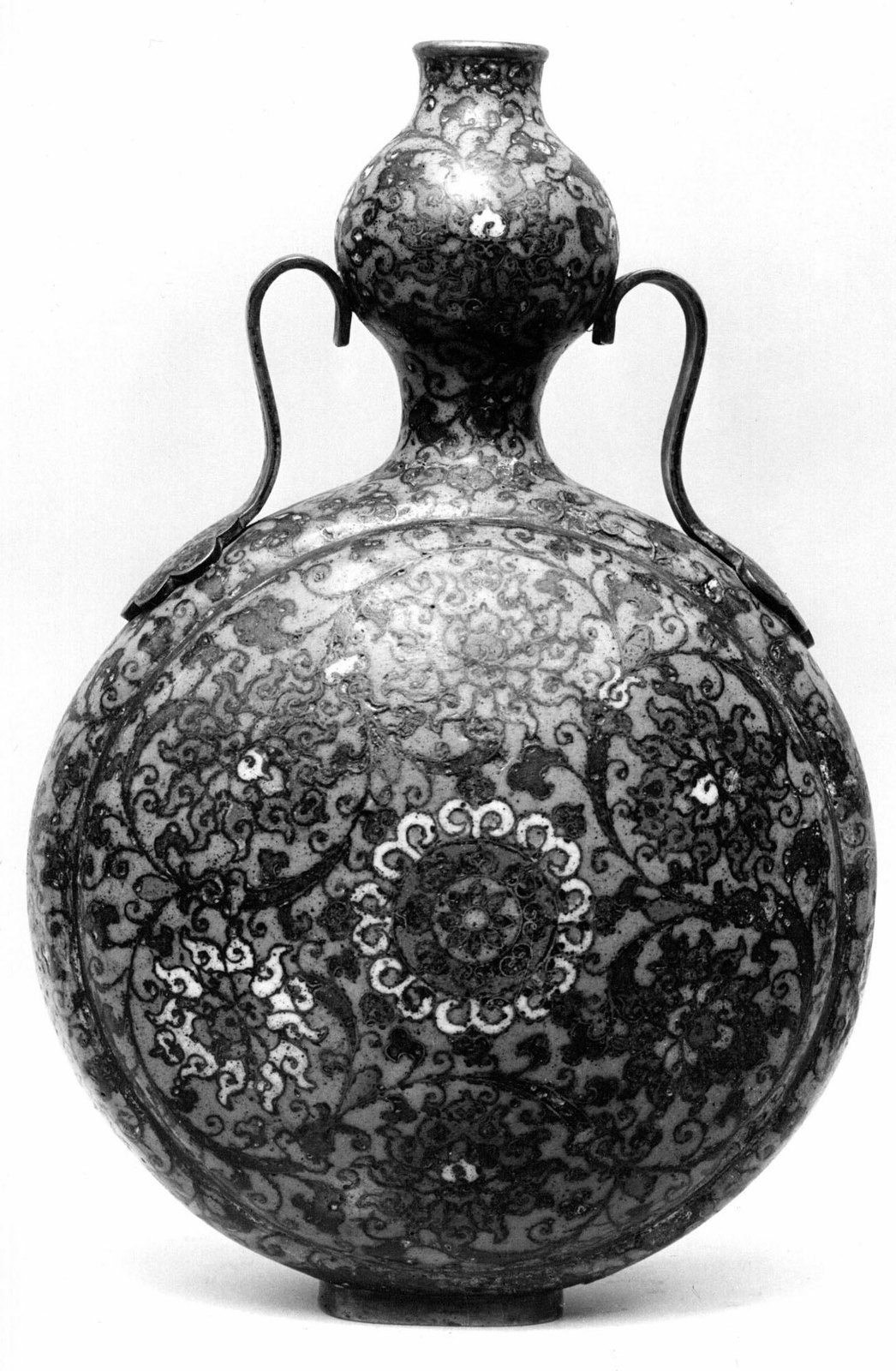
The museum's available primary image of a late Ming pilgrim bottle is monochrome. That is a limitation for an essay about enamel colour, and it should remain visible as a limitation. We cannot reconstruct the original palette from grey tones, or confidently compare its saturation with the dish. The photograph is useful here for a different reason: it makes silhouette and surface density easier to separate.
The broad body, narrower upper section and paired handles create an outline that is immediately unlike either the dish or the box. Trace that outline first, then return to the ornament. The comparison shows why identifying a technique does not finish the encounter. Three objects can share an enamel method while asking the eye to travel in different ways: around a circle, across adjoining planes, or along a bottle's changing profile.
A way to carry the lesson into a gallery
On your next encounter with a richly coloured vessel, begin with three ordinary questions: what is the body, what holds the colour, and how does the design turn a corner? You may not answer all three from a display case. Even so, asking them slows the jump from visual excitement to a vague label such as “ornate.” The object becomes a series of material choices rather than an interchangeable luxury surface.
For a contrasting relationship between colour and support, continue with blue-and-white porcelain. Or return to empty space in landscape painting: density and openness are different ways of directing attention, not a competition between sophisticated and unsophisticated taste. Cloisonné rewards the moment when we stop asking whether there is too much decoration and start asking how that decoration is held together.
Join the conversation
What did this make you notice?
Which changes your experience more: seeing the whole silhouette, or enlarging the tiny metal boundaries?