
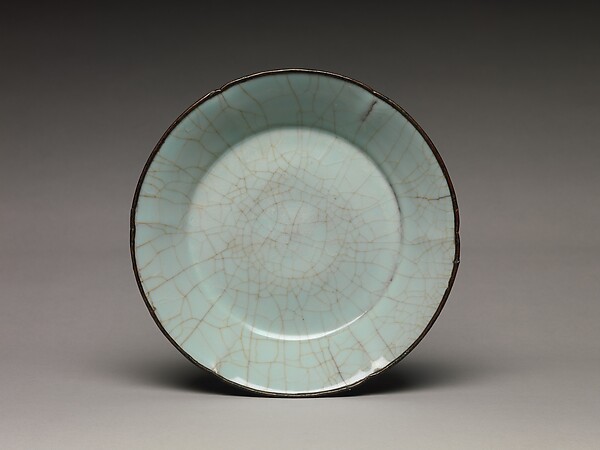
What makes a glaze crack?
A ceramic body and its glaze expand and contract at different rates in the kiln. If their thermal behaviour does not match, tension can fracture the glassy glaze after firing. Potters normally try to prevent this phenomenon, known as crazing. Song-period makers, however, learned that it could be directed.
The cracks did not form as painted decoration. They arose within the material system itself. Their density depended on clay, glaze composition, thickness, firing and cooling. Pigment or staining could later settle into the fissures, making the network easier to see. The result was regular enough to belong to a family of wares, but never mechanically identical.
This distinction matters. The potter designed the conditions; the kiln completed the pattern. Calling every line “accidental” ignores craft. Calling it entirely controlled ignores fire.
A court remade in the south
After the Northern Song court lost its northern capital in the twelfth century, the Southern Song established its capital at present-day Hangzhou. Courtly ceramic production was rebuilt in this new setting. Guan—literally “official”—ware is associated with kilns serving that court.
The Metropolitan Museum of Art describes Southern Song Guan ware as an attempt to recreate prestigious northern ceramics, especially the rare Ru ware admired at court. Yet Guan developed its own presence: dark clay bodies, softly coloured glazes and conspicuous networks of crackle. Some vessels have a bluish translucence; others appear grey-green, cream or almost smoky.
The forms are often restrained. Without painted scenes or bright colour, attention moves toward proportion, rim, foot, glaze depth and the map of cracks. What seems quiet becomes intensely eventful when seen closely.
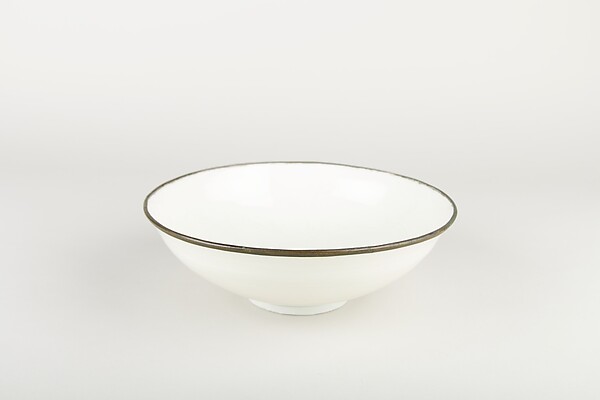
Why the lines feel alive
Crackle works because it sits between order and disorder. No two networks are identical, yet the eye senses a coherent field. A thicker line may cross several finer ones; a pale area may suddenly become dense. The surface seems to hold both geological time and an instant of cooling.
Later connoisseurs developed names for different crackle effects, but poetic labels should not be mistaken for a single timeless code shared by every workshop or viewer. Technical analysis, archaeology and dated collections remain essential. “Chinese crackle” is not one formula: it describes multiple materials and histories.
The object also changes after leaving the kiln. Handling, burial, staining and restoration can alter the visibility of cracks. A museum photograph freezes one moment in a much longer material biography.
Imperfection is not the whole story
It is tempting to describe crackle with the modern slogan that imperfection is beautiful. That is partly true, but too simple. These vessels were elite objects whose apparent irregularity depended on extraordinary knowledge and selection. Many failed firings would still have been discarded. The admired surface was not carelessness; it was disciplined uncertainty.
Nor should crackle be treated as proof of age. Later Chinese potters deliberately imitated earlier wares, and ceramic traditions elsewhere adopted crackled glazes. A network of lines can be aesthetically convincing without establishing when or where an object was made. Dating requires clay, glaze, form, kiln evidence and provenance together.
How to look at a crackled vessel
Begin by changing distance. From across a room, notice silhouette and colour. Up close, follow one line until it meets another. Look at the rim, where glaze thins, and the foot, where the body may be exposed. Ask whether the crackle is tight or spacious, darkened or barely visible.
Then notice your own expectation. Did you first read the lines as damage? At what point did they become composition? Guan ware does not erase the difference between flaw and beauty. It asks us to see how culture, technique and attention can renegotiate that boundary.
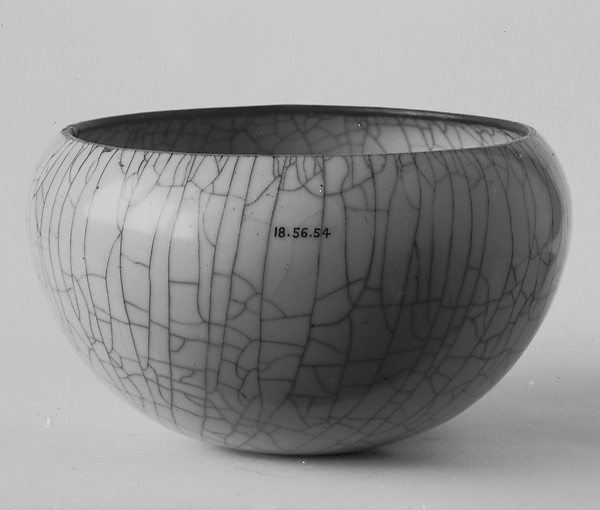
The afterlife of a surface
Crackle did not remain confined to one Southern Song court. Later kilns revisited official-ware aesthetics, collectors ranked and renamed admired surfaces, and European and Japanese potters developed their own responses to crazing. In modern interiors, a crackled vase can be sold as an instant sign of age, calm or “Asian” taste. That long afterlife proves the visual idea was powerful, but it can also detach the surface from its history.
Looking historically means resisting the shortcut. Rather than treating every crackled object as the same symbol, ask who made it, for which market and in conversation with which earlier ware. A contemporary studio potter may use crackle as experimental chemistry; an eighteenth-century imperial workshop might cite Song precedent; a mass-produced decorative jar may imitate both. Similar lines can carry very different ambitions. The most respectful admiration begins not with a universal philosophy of brokenness, but with the specificity of clay, kiln and human decision.
Join the conversation
What did this make you notice?
When does a material irregularity become an artistic choice—and who gets to decide?